
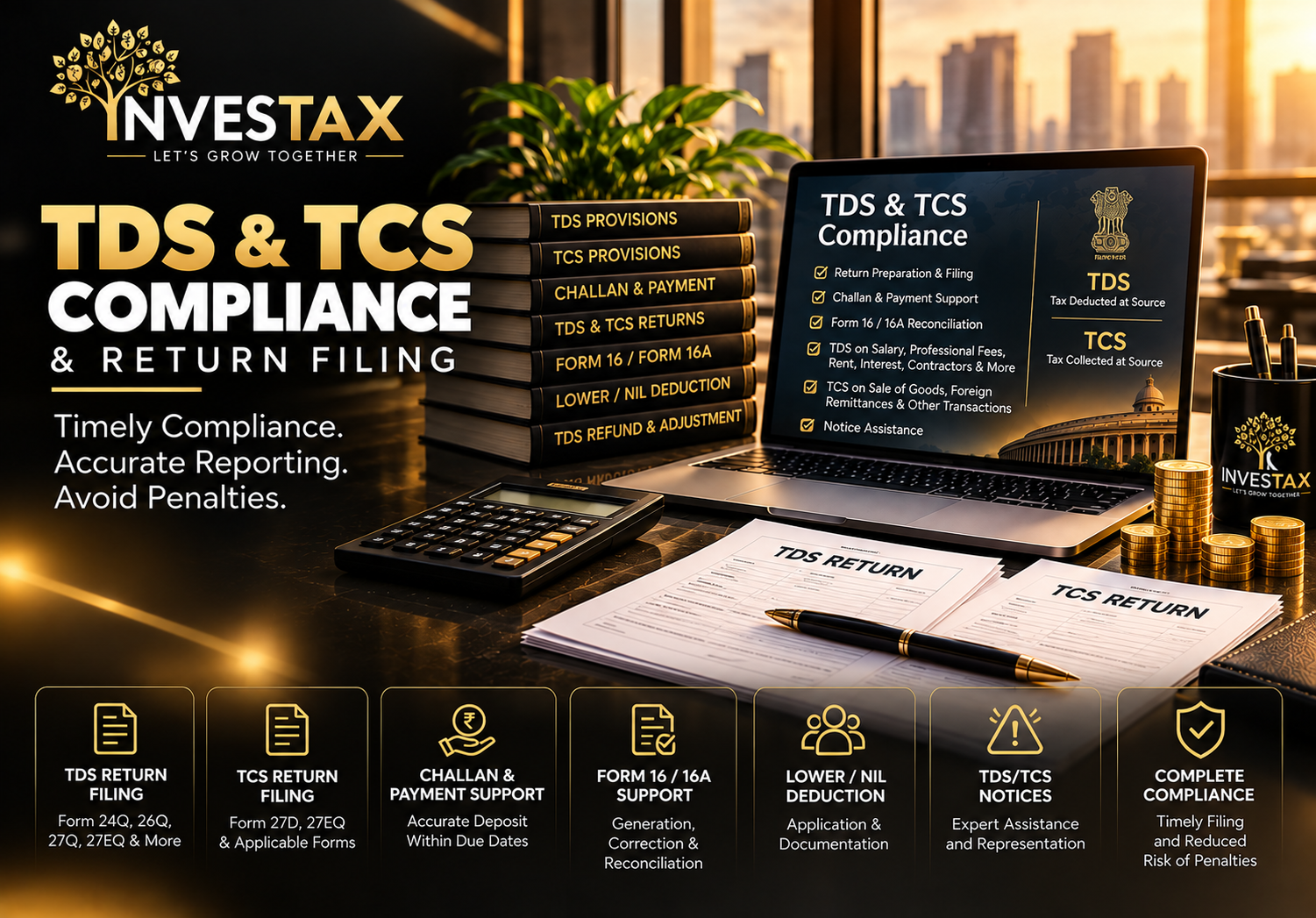
TDS & TCS Compliance & Return Filing
Tax Deducted at Source (TDS) and Tax Collected at Source (TCS) are important components of India's income-tax compliance system. Depending on the nature of payment or transaction, a person or business may be required to deduct or collect tax, deposit it with the government and report the transaction through prescribed statements and forms.
At Investax India, we provide comprehensive TDS and TCS compliance services for companies, partnership firms, LLPs, proprietorships, professionals, employers and other persons who have applicable deduction or collection obligations.
Our services cover the complete compliance cycle, from determining applicability and reviewing transactions to deduction or collection, challan payment, statement filing, certificate generation, reconciliation, correction and notice assistance.
Important Update: TDS & TCS Under the Income-tax Act, 2025
The Income-tax Act, 2025 applies from 1 April 2026, subject to the applicable transition provisions. TDS and TCS compliance therefore needs to be considered separately for transactions governed by the old and new Acts.
The Income Tax Department states that where the earlier event of credit or payment occurs on or before 31 March 2026, the corresponding TDS provisions under the Income-tax Act, 1961 apply. Where the earlier event occurs on or after 1 April 2026, the provisions under the Income-tax Act, 2025 apply.
For Tax Year 2026-27 onwards, taxpayers should use the applicable forms, challans and procedures prescribed under the Income-tax Act, 2025 and Income-tax Rules, 2026.
What is TDS?
TDS stands for Tax Deducted at Source. Under specified provisions, the person responsible for making certain payments is required to deduct tax at source and deposit the amount with the Central Government.
TDS may apply to specified payments such as salary, interest, commission, professional fees, contractual payments, rent and other payments depending on the applicable provisions and prescribed conditions.
The amount deducted as TDS is generally reflected in the recipient's tax records and can be considered while determining the recipient's final tax liability, subject to the applicable provisions.
What is TCS?
TCS stands for Tax Collected at Source. Under specified provisions, the person responsible for collecting tax is required to collect the prescribed amount from the buyer or other specified person and deposit it with the government.
TCS provisions can apply to specified transactions and categories prescribed under the applicable income-tax law.
Proper identification of the applicable transaction, collection requirement, reporting and credit information is important for accurate TCS compliance.
TDS & TCS Compliance Services
TDS Applicability Review
Review of payments and transactions to determine whether TDS provisions apply and identify the applicable provision and compliance requirements.
TCS Applicability Review
Assistance in identifying transactions covered by TCS provisions and determining applicable collection and reporting requirements.
TDS Return Filing
Preparation and filing of applicable quarterly TDS statements with transaction-level reporting and required validation.
TCS Return Filing
Preparation and filing of applicable TCS statements with collection details and required transaction reporting.
Challan & Tax Payment
Assistance with TDS/TCS challan preparation, payment and reconciliation with the relevant statements.
Form 16 & Form 16A
Assistance with TDS certificate generation, reconciliation and correction of reported information where applicable.
Correction Statements
Assistance with identifying and correcting errors in previously filed TDS or TCS statements.
Notice & Demand Assistance
Support in understanding TDS/TCS notices, defaults, demands and applicable compliance requirements.
TDS Return Filing Under the New Framework
The Income-tax Act, 2025 and Income-tax Rules, 2026 introduce a revised framework of forms and procedures for TDS and TCS reporting.
For example, the Income Tax Department identifies Form 138 as the quarterly statement corresponding to the earlier Form 24Q for TDS on salary, pension or specified interest income.
Similarly, Form 140 is the quarterly statement corresponding to the earlier Form 26Q for TDS on specified non-salary payments to residents. These forms are filed quarterly according to the prescribed schedule.
For payments to non-residents, the Department provides Form 144 for reporting specified non-salary TDS. The applicable form depends on the nature of the payment and taxpayer circumstances.
The Income Tax Department's current guidance should be followed for the applicable Tax Year and transaction type.
Quarterly TDS Statements
Persons responsible for deducting tax are generally required to report TDS through prescribed quarterly statements.
Salary TDS
Applicable employers and specified deductors report salary-related TDS through the prescribed quarterly statement.
Resident Non-Salary TDS
TDS on applicable payments to residents is reported through the prescribed quarterly statement.
Non-Resident Payments
Applicable TDS on payments to non-residents is reported through the prescribed statement and compliance mechanism.
Correction Statements
Corrections can be filed where eligible to address errors or omissions in previously submitted statements.
TDS Statement Filing Due Dates
The Income Tax Department currently prescribes quarterly due dates for applicable TDS statements. Under the new framework, the quarterly schedule for the principal statements includes:
- April – June: 31 July
- July – September: 31 October
- October – December: 31 January
- January – March: 31 May of the following financial year
For example, the Income Tax Department's current Form 138 guidance specifies these quarterly filing dates for the applicable salary TDS statement.
TDS Payment & Challan Compliance
Deducted or collected tax must be deposited with the government within the applicable statutory timeline.
The Income Tax Department states that under the Income-tax Act, 2025, the applicable payment timelines are prescribed through the Income-tax Rules, 2026 and broadly retain the existing timelines.
For Tax Year 2026-27 onwards, the Department provides new challan forms, including ITNS 281N for applicable TDS/TCS payments under the Income-tax Act, 2025.
Form 16 and Form 16A
TDS certificates provide details of tax deducted at source and are important for recipients when preparing their Income Tax Returns.
Form 16 is generally associated with TDS on salary, while Form 16A is used for specified TDS on income other than salary.
Proper reconciliation between the TDS certificate, tax records and the corresponding income helps reduce discrepancies during Income Tax Return filing.
Lower or Nil TDS Deduction
Certain taxpayers may be eligible to seek lower or nil deduction of tax at source where the applicable statutory conditions are satisfied.
The relevant application, certificate, documentation and procedural requirements depend on the applicable provision and taxpayer circumstances.
Investax India can assist in reviewing the applicable requirements and documentation for eligible cases.
TDS & TCS Reconciliation
Reconciliation is an important part of TDS and TCS compliance because differences between books, challans, filed statements and tax records can result in mismatches or demands.
Our reconciliation process may include reviewing:
- TDS/TCS deducted or collected
- Challan payments
- Quarterly statements
- Deductor or collector details
- PAN and TAN information
- Transaction-level reporting
- Form 16 and Form 16A information
- Tax credit appearing in applicable tax records
- Previous-period corrections and adjustments
TDS & TCS Correction Statements
Errors in a filed TDS or TCS statement can create mismatches for the deductor, collector or deductee. Depending on the nature of the error, a correction statement may be required.
Common issues may include incorrect PAN, incorrect amount, incorrect section, incorrect challan details, missing transactions or other reporting discrepancies.
Investax India can assist with reviewing the discrepancy and preparing the applicable correction process.
TDS & TCS Notices and Defaults
TDS/TCS defaults can arise from delayed payment, incorrect reporting, non-filing, short deduction or collection, incorrect challan details or other compliance issues.
A notice or demand should be reviewed carefully to identify the relevant period, transaction, provision and amount involved.
Investax India provides assistance in understanding TDS/TCS communications, reconciling records and addressing applicable compliance requirements.
TAN – Tax Deduction and Collection Account Number
TAN stands for Tax Deduction and Collection Account Number. It is a 10-digit alphanumeric number issued by the Income Tax Department.
The Income Tax Department states that persons responsible for deducting or collecting tax at source are generally required to obtain and quote TAN in applicable TDS/TCS returns, challans, certificates and other prescribed documents.
The same TAN can be used for applicable TDS and TCS compliance; a separate TAN is not required merely because a person also has TCS obligations.
Our TDS & TCS Compliance Process
- Review the nature of payments and transactions.
- Determine applicable TDS or TCS provisions.
- Review PAN, TAN and other required information.
- Calculate the applicable deduction or collection.
- Prepare and deposit the applicable challan.
- Record transactions accurately in the accounting records.
- Prepare the applicable quarterly statement.
- Validate and submit the statement.
- Generate and reconcile applicable certificates.
- Review tax-credit and transaction information.
- Address corrections or mismatches where required.
- Maintain records for future compliance and assessment.
Who Can Avail Our TDS & TCS Services?
- Private Limited Companies
- Public Limited Companies
- LLPs
- Partnership Firms
- Proprietorship Businesses
- Employers
- Professionals
- Government and specified entities
- Businesses making payments to residents
- Businesses making specified payments to non-residents
- Persons having applicable TCS obligations
Why Choose Investax India for TDS & TCS Compliance?
TDS and TCS compliance involves more than depositing tax. Correct applicability, accurate deduction or collection, timely payment, proper reporting and reconciliation are all important parts of the compliance cycle.
Investax India provides an organised approach to TDS and TCS compliance, helping businesses manage recurring filing requirements and address discrepancies when they arise.
- TDS & TCS applicability review
- Quarterly return preparation and filing
- Challan and payment assistance
- Form 16 and Form 16A support
- Reconciliation and mismatch review
- Correction statement assistance
- Lower/Nil deduction assistance
- TDS/TCS notice assistance
- New Income-tax Act, 2025 transition support
Frequently Asked Questions About TDS & TCS
What is TDS?
TDS stands for Tax Deducted at Source. Under specified provisions, tax is deducted by the person responsible for making certain payments and deposited with the government.
What is TCS?
TCS stands for Tax Collected at Source. Under specified provisions, tax is collected by the person responsible for collection from the buyer or other specified person and deposited with the government.
What is the difference between TDS and TCS?
TDS is tax deducted from specified payments by the payer, whereas TCS is tax collected by the specified collector on applicable transactions.
What is TAN?
TAN is the 10-digit Tax Deduction and Collection Account Number issued by the Income Tax Department to persons responsible for applicable TDS or TCS compliance.
Is a separate TAN required for TDS and TCS?
No. Where a person already has a TAN, the same TAN can generally be quoted for applicable TDS and TCS compliance.
What is a TDS return?
A TDS statement is a prescribed periodic statement through which a deductor reports applicable TDS transactions, deductions and related information to the Income Tax Department.
What is a TCS return?
A TCS statement reports applicable transactions, amounts collected and other prescribed information to the Income Tax Department.
What is Form 24Q under the old framework?
Form 24Q was the quarterly TDS statement used for salary-related deductions under the Income-tax Act, 1961. Under the Income-tax Act, 2025 framework, the corresponding form is Form 138.
What is Form 26Q under the old framework?
Form 26Q was the quarterly TDS statement for specified non-salary payments to residents. Under the new framework, the corresponding form is Form 140.
What is Form 138?
Form 138 is the quarterly statement corresponding to the earlier Form 24Q for specified TDS on salary, pension or interest income. The Income Tax Department provides quarterly filing due dates for this form.
What is Form 140?
Form 140 is the quarterly statement corresponding to the earlier Form 26Q for TDS on specified non-salary payments to residents.
What happens to TDS provisions during the transition to the new Act?
For transactions where the earlier event of credit or payment occurs on or before 31 March 2026, the old Act applies. Where the earlier event occurs on or after 1 April 2026, the TDS provisions under the Income-tax Act, 2025 apply.
What is Form 141?
Form 141 is a consolidated challan-cum-statement introduced under the Income-tax Act, 2025 for specified transactions. It brings together certain transactions that previously used separate challan-cum-TDS statement forms.
What is ITNS 281N?
ITNS 281N is a challan used for applicable TDS/TCS payments under the Income-tax Act, 2025 for Tax Year 2026-27 onwards.
Can TDS/TCS statements be corrected?
Where permitted, correction statements can be submitted to address eligible errors or omissions in previously filed statements.
Can Investax India help with TDS/TCS notices?
Yes. Investax India can assist in reviewing TDS/TCS notices, identifying the relevant issue, reconciling records and addressing applicable compliance requirements.
Can Investax India handle regular TDS/TCS compliance?
Yes. Investax India can assist businesses with recurring TDS/TCS compliance, including applicability review, payment, statement filing, reconciliation, certificates and correction requirements.
Stay Compliant With TDS & TCS
TDS and TCS compliance requires timely action throughout the year rather than only at the time of filing a return. Correct deduction or collection, timely payment, accurate reporting and reconciliation can help maintain proper tax records and address discrepancies promptly.
With the Income-tax Act, 2025 now applicable to Tax Year 2026-27 onwards, businesses should also ensure that the correct Act, provision, form and challan are used for the relevant transaction and period.
Connect with Investax India for TDS & TCS Compliance, Return Filing, Reconciliation and Notice Assistance.