
Remove Director
Investax India assists companies with director resignation, removal and cessation-related compliances, including documentation, resolutions, MCA filings and post-removal statutory updates.
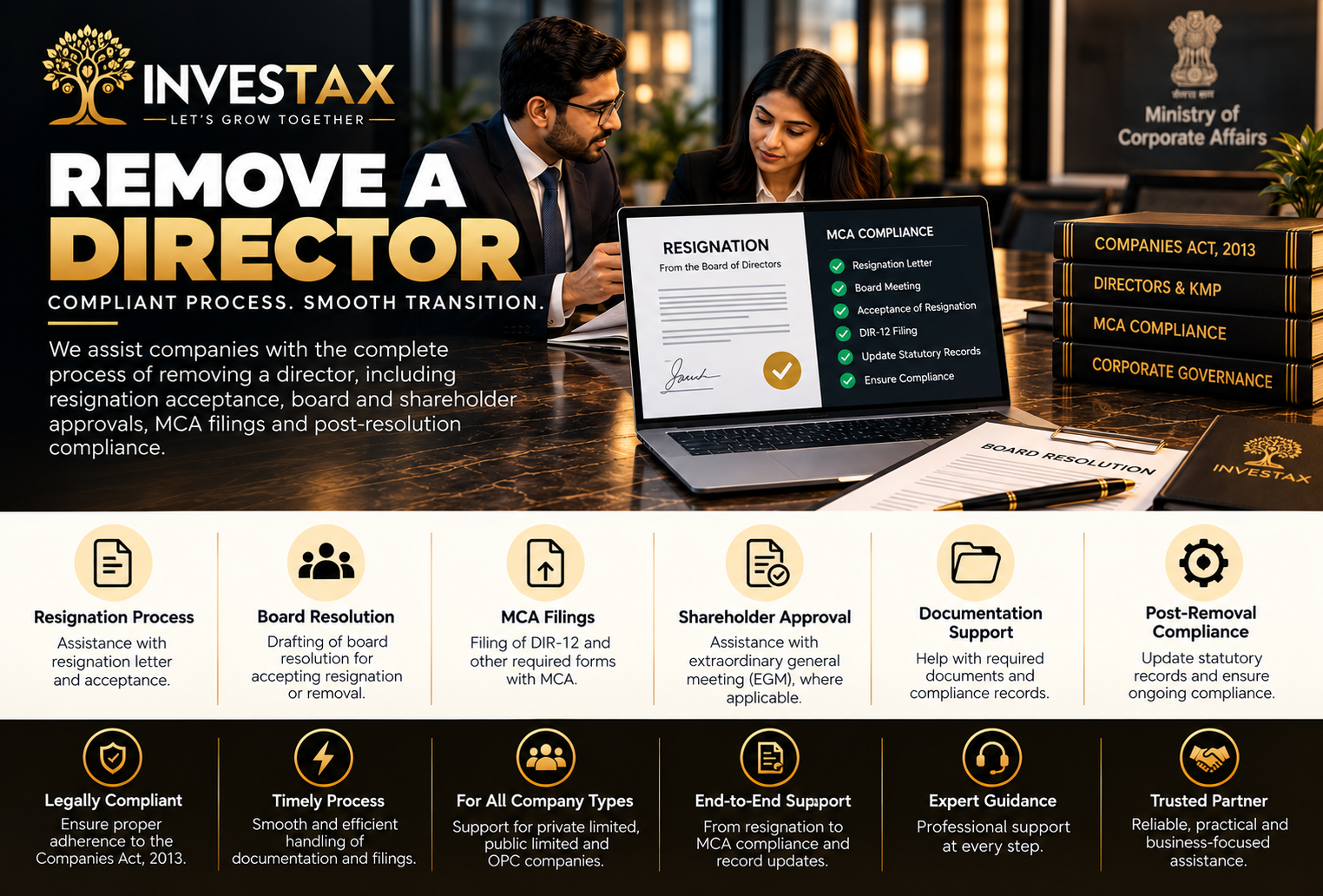
Remove a Director from Your Company
Directors may cease to hold office for several different reasons, including resignation, removal by the company, disqualification or other circumstances prescribed under the Companies Act, 2013.
Removing a director is therefore not simply a matter of deleting the person's name from the company's records. The correct legal procedure, approvals, documentation and MCA filing depend on the reason for cessation and the type of director involved.
Investax India provides end-to-end assistance for director resignation, removal and cessation compliance, including documentation, Board and shareholder processes where applicable, Form DIR-12 filing and post-removal compliance.
What Does Removing a Director Mean?
Removing a director means bringing the individual's tenure as a director of the company to an end and completing the applicable statutory and corporate formalities.
The Companies Act, 2013 recognises different circumstances in which a director may cease to hold office. These include resignation, vacation of office and removal in accordance with the applicable provisions of law.
The appropriate process should be determined based on the actual circumstances rather than treating every director exit as the same type of transaction.
Different Ways a Director Can Cease to Hold Office
A director may cease to hold office through different legal routes, including:
- Resignation by the director
- Removal by the company
- Vacation of office under applicable provisions
- Cessation following disqualification
- Expiry of the applicable tenure in circumstances prescribed by law
- Other circumstances recognised under the Companies Act, 2013
Each situation can have different documentation, approval and filing requirements.
Director Resignation
A director may voluntarily resign from the Board by giving written notice to the company.
Under Section 168 of the Companies Act, 2013, the resignation takes effect from the date on which the notice is received by the company or the later date specified by the director in the notice, as applicable.
The company is required to intimate the Registrar in the prescribed manner and the resignation must also be appropriately reflected in the company's corporate records.
A copy of the resignation along with the reasons is also subject to the statutory filing requirements applicable to the resigning director.
Removal of a Director by the Company
Removal by the company is different from voluntary resignation.
Section 169 of the Companies Act, 2013 provides the statutory framework for removal of directors in circumstances covered by that provision. The procedure can involve notice, an opportunity of being heard and approval by the members through the applicable resolution process.
Because removal can affect the rights of the concerned director, the company should follow the prescribed procedure carefully and maintain proper records of notices, resolutions and proceedings.
Vacation of Office of a Director
Section 167 of the Companies Act, 2013 specifies circumstances in which the office of a director becomes vacant.
These circumstances can include certain disqualifications, prolonged absence from Board meetings, specified violations relating to interests in contracts or arrangements, certain court or Tribunal orders, specified convictions and removal under the Act.
Vacation of office is therefore different from a voluntary resignation or a shareholder-driven removal.
Resignation vs Removal of a Director
| Particular | Resignation | Removal |
|---|---|---|
| Who initiates it? | Generally the director | Company/members following the applicable legal process |
| Nature | Voluntary exit | Removal through statutory procedure |
| Section | Section 168 | Section 169 |
| Special procedure | Written resignation and prescribed filings | Notice, hearing and applicable member approval requirements |
| MCA filing | DIR-12 and other applicable filings | DIR-12 and other applicable filings |
Procedure for Removing a Director Due to Resignation
Step 1 – Receive the Resignation
The company receives the director's written resignation and records the date of receipt.
Step 2 – Review the Resignation
The resignation letter and applicable reasons or supporting information are reviewed and placed before the appropriate authority of the company.
Step 3 – Board Takes Note of Resignation
The Board takes note of the resignation in accordance with the applicable provisions and company procedures.
Step 4 – Prepare Required Documentation
The relevant minutes, resolutions, resignation documents and supporting records are prepared and maintained.
Step 5 – File DIR-12
The company files the applicable cessation details with the Registrar of Companies through Form DIR-12.
Step 6 – Update Statutory Records
The company's statutory registers, internal records and other relevant corporate documentation should be updated following the cessation.
Procedure for Removal of a Director by the Company
Where the company intends to remove a director rather than process a voluntary resignation, the applicable procedure under Section 169 and related provisions should be followed.
Step 1 – Review the Legal Position
The company should first determine whether the proposed removal falls within the applicable statutory framework and whether any special provisions apply to the director concerned.
Step 2 – Issue the Required Notice
The prescribed notice and meeting requirements should be followed. The concerned director must be given the opportunity required under the applicable provisions.
Step 3 – Convene the Appropriate Meeting
The company follows the applicable Board and general meeting procedure for considering the proposed removal.
Step 4 – Pass the Required Resolution
Where required, the members consider and pass the appropriate resolution in accordance with the Companies Act, 2013.
Step 5 – Complete MCA Filing
Once the cessation becomes effective, the company files the applicable cessation details with the Registrar through the prescribed MCA filing process.
Step 6 – Update Corporate Records
The company updates its statutory registers, minutes, Board records and other relevant corporate documents.
What Is Form DIR-12?
Form DIR-12 is an MCA webform used for reporting particulars relating to appointment, cessation and changes in designation of directors and key managerial personnel.
The MCA's DIR-12 instruction kit states that companies are required to file the webform with the Registrar within 30 days from the date of appointment, cessation or change in designation, subject to applicable requirements.
Proper documentation should therefore be prepared before filing so that the information reported to MCA corresponds with the company's underlying corporate records.
Documents Required for Director Resignation or Removal
The exact documents depend on the circumstances of cessation. Common documents may include:
- Director's resignation letter, where applicable
- Reason for resignation, where applicable
- Board resolution or minutes
- Notice of general meeting, where applicable
- Explanatory statement, where applicable
- Special or ordinary resolution, depending on the circumstances and applicable law
- Notice and correspondence relating to proposed removal
- Proof of dispatch/service of notices, where required
- DIR-12 supporting documents
- Updated statutory records
Removal of Director Due to Disqualification
A director may cease to hold office where circumstances specified under Section 167 arise, including certain disqualifications referred to under the Companies Act.
Such cases should not automatically be treated as ordinary resignation or voluntary removal. The company should determine the applicable statutory provision and complete the corresponding compliance requirements.
Can a Director Resign Without Board Approval?
A director's resignation is fundamentally based on written notice given to the company. Under Section 168, the Board takes note of the resignation and the company completes the prescribed filing and record-keeping requirements.
The effective date should be determined in accordance with the applicable statutory provision and the resignation notice.
Can a Company Force a Director to Resign?
A company should not treat a forced resignation as though it were a voluntary resignation without considering the actual circumstances.
Where the company intends to remove a director, the applicable statutory procedure for removal should be followed rather than inaccurately documenting the event as a voluntary resignation.
Removal of a Director from a Private Limited Company
Private Limited Companies may need to remove or record the cessation of a director because of resignation, management restructuring, change in ownership or other circumstances.
The correct procedure depends on whether the director is resigning voluntarily, is being removed by the company or has ceased to hold office under another statutory provision.
Removal of a Director from an OPC
One Person Companies have specific provisions governing their structure and management. Any change involving the director should be reviewed in light of the applicable provisions and the company's particular circumstances.
Removal of a Director from a Public Limited Company
Public companies are subject to additional requirements relating to Board composition and appointment and removal of directors.
Before proceeding with cessation, the company should verify that the remaining Board composition continues to comply with applicable requirements.
What Happens After a Director Is Removed?
Completion of the cessation process does not necessarily end the company's compliance work.
The company may need to:
- File the applicable MCA form
- Update the Register of Directors and KMP
- Update Board and statutory records
- Update authorised signatory information where applicable
- Review banking mandates where applicable
- Review MCA portal access and DSC associations where relevant
- Update internal corporate documentation
- Assess whether the company continues to satisfy applicable Board composition requirements
Impact of Director Removal on Company Compliance
The exit of a director can affect the company's governance structure, signing authorities and Board composition.
Before completing the cessation, companies should therefore review whether the remaining directors satisfy the minimum requirements applicable to their company and whether any special category of director needs to be maintained.
Common Mistakes While Removing a Director
- Treating resignation and removal as the same process
- Failing to record the correct effective date
- Missing the applicable MCA filing timeline
- Using incorrect cessation details in DIR-12
- Failing to maintain proper Board or shareholder records
- Not following the applicable notice procedure for removal
- Ignoring the director's statutory rights during removal proceedings
- Failing to update statutory registers
- Not checking the company's remaining Board composition
- Leaving the former director listed in outdated internal records
Why Choose Investax India for Director Removal Services?
- Complete Process Assistance: Support from initial documentation through MCA filing.
- Correct Process Identification: Assistance in distinguishing resignation, removal and other cessation situations.
- Documentation Support: Guidance regarding applicable letters, notices, resolutions and supporting records.
- MCA Filing Support: Assistance with the applicable DIR-12 filing process.
- Corporate Compliance: Support for maintaining appropriate statutory records.
- Post-Cessation Guidance: Assistance with relevant compliance following the director's exit.
- Practical Approach: Clear guidance for startups, SMEs and established companies.
Who Can Use Our Director Removal Services?
- Private Limited Companies
- Public Limited Companies
- One Person Companies
- Startups
- Family-owned businesses
- Companies undergoing management restructuring
- Companies processing director resignations
- Companies requiring statutory cessation filings
Frequently Asked Questions
1. Can a director resign from a company?
Yes. A director may resign by giving written notice to the company, subject to the applicable provisions of the Companies Act, 2013.
2. What is the difference between resignation and removal?
Resignation is generally initiated by the director, while removal is a statutory process initiated by the company/members under the applicable provisions.
3. Which section deals with resignation of a director?
Section 168 of the Companies Act, 2013 deals with resignation of directors.
4. Which section deals with removal of a director?
Section 169 of the Companies Act, 2013 deals with removal of directors.
5. What is Section 167?
Section 167 deals with circumstances in which the office of a director becomes vacant.
6. Is DIR-12 required when a director resigns?
The company is required to report the relevant cessation to the Registrar through the applicable MCA filing process, including DIR-12 where applicable.
7. How long does the company have to file DIR-12?
The MCA DIR-12 instruction kit states that the webform is generally required within 30 days from the date of cessation, subject to applicable requirements.
8. Can a company remove a director without the director's consent?
Removal and resignation are different processes. Where the company seeks to remove a director, the applicable statutory procedure, including the required notice and opportunity of being heard, must be followed.
9. Is shareholder approval required to remove a director?
Removal under Section 169 involves the applicable member approval process. The exact procedure depends on the circumstances and statutory requirements.
10. Can a director be removed because of disqualification?
Certain circumstances involving disqualification can result in vacation of office under Section 167. The applicable statutory provision should be reviewed based on the specific circumstances.
11. What documents are required for director resignation?
Common documents include the resignation letter, relevant corporate resolutions or minutes, supporting records and the documents required for the applicable MCA filing.
12. What documents are required for removal of a director?
The requirements can include notices, meeting documents, resolutions, supporting records and MCA filing documents. The exact requirements depend on the type of removal.
13. Can the same DIR-12 process be used for resignation and removal?
DIR-12 is used to report director cessation, but the underlying corporate procedure and reason for cessation are different. The filing should accurately reflect the actual event.
14. Can a director resign immediately?
The effective date of resignation is governed by Section 168 and the terms of the resignation notice. The applicable circumstances should be reviewed before determining the effective date.
15. What happens if DIR-12 is filed late?
Late filing may result in additional fees and other consequences under applicable law. Companies should follow the prescribed filing timeline.
16. Can a director be removed if there is a dispute with the company?
A dispute does not by itself eliminate the statutory procedure. Where removal is proposed, the company should follow the applicable legal process and maintain proper documentation.
17. Does the company need to update its statutory registers?
Yes. The company's statutory and internal records should be updated to accurately reflect the director's cessation.
18. What happens to the former director's DIN?
Cessation from one company does not by itself mean that the individual's DIN ceases to exist. DIN-related status and obligations are governed by the applicable MCA provisions.
19. Can a director who resigned remain liable for past acts?
Resignation does not automatically erase liabilities or responsibilities arising from actions or periods when the person was a director. The specific facts and applicable law determine the position.
20. Can Investax India handle the complete director removal process?
Yes. Investax India can assist with the applicable documentation, corporate compliance process, MCA filing and post-cessation records, depending on the nature of the director's exit.
Complete the Director Exit Process Correctly
Removing or recording the cessation of a director is an important corporate compliance activity. The correct procedure depends on whether the director has resigned, is being removed by the company or has ceased to hold office under another statutory provision.
Investax India helps businesses manage the documentation, resolutions, MCA filings and related compliance involved in director cessation.
Complete the process correctly. Keep your MCA records updated. Maintain compliant corporate governance.
Need help with Remove Director?
Get practical guidance on requirements, documentation, compliance and the right service for your needs.