
Import/Export Code
Importing or exporting goods involves more than obtaining an Importer Exporter Code. Businesses need to understand DGFT requirements, customs procedures, documentation, product-specific regulations, customs duties, valuation and other applicable compliances.
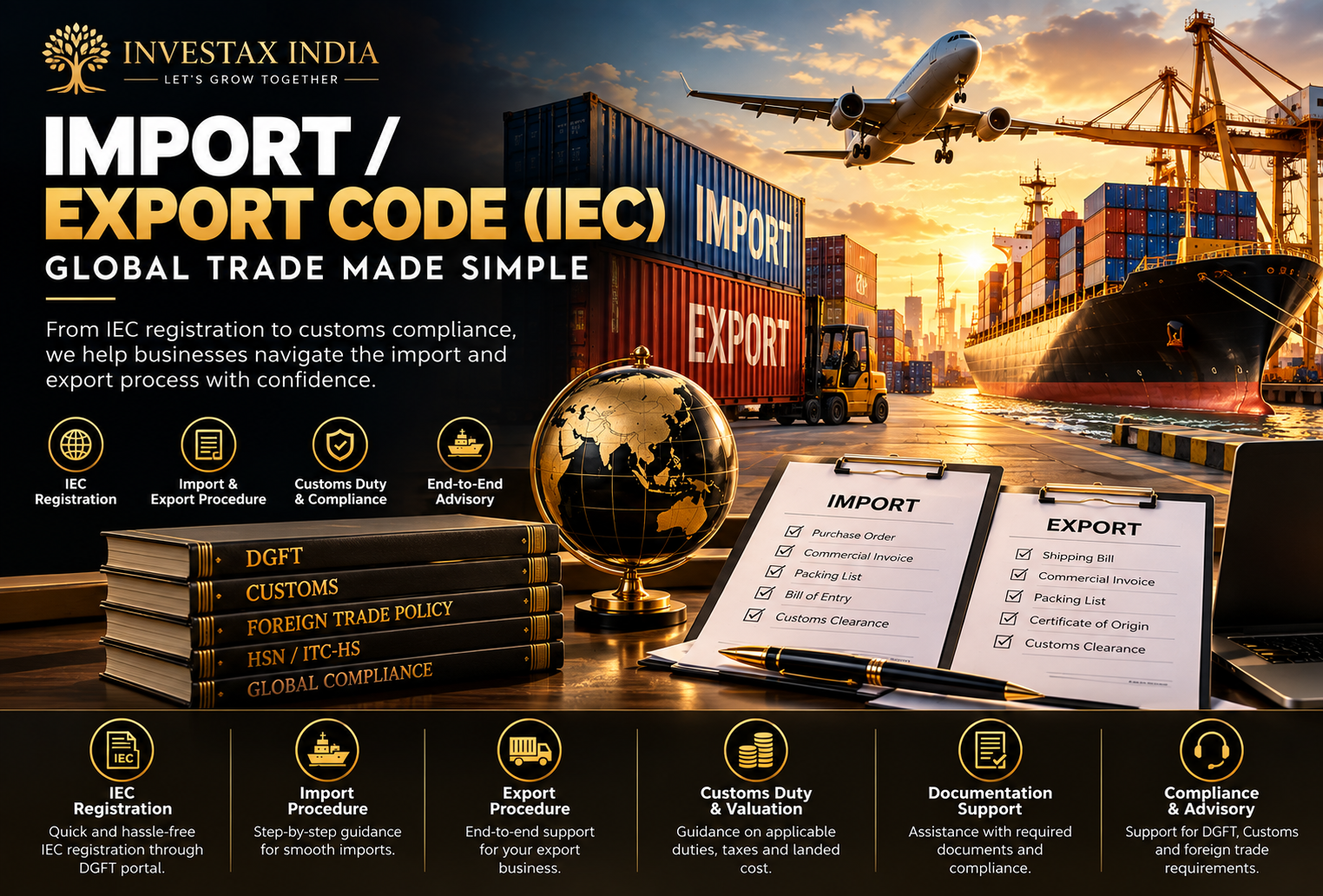
Import / Export Code (IEC) & International Trade Services
Start Trading Globally With the Right Compliance in Place.
International trade can open new markets, suppliers and business opportunities, but importing and exporting goods also involves regulatory, customs and documentation requirements. A business may need to comply with requirements relating to the Importer Exporter Code (IEC), DGFT, Customs, GST, product-specific regulations and other applicable authorities.
At Investax India, we assist businesses with IEC registration and related import-export compliance requirements, helping you understand the process from setting up your trade documentation to managing customs and ongoing compliance requirements.
What is Importer Exporter Code (IEC)?
Importer Exporter Code, commonly known as IEC, is an identification number issued by the Directorate General of Foreign Trade (DGFT) for eligible persons or entities undertaking import or export activities.
IEC is generally required for undertaking import or export of goods from or to India, subject to applicable exemptions. Under the current framework, IEC is linked to the entity's PAN and is issued electronically by DGFT.
Businesses holding an IEC should also ensure that the details associated with the IEC are kept updated in accordance with the applicable DGFT requirements.
Our Import & Export Services
IEC Registration
We assist businesses with obtaining their Importer Exporter Code through the DGFT portal, including application preparation, documentation and submission support.
IEC Modification & Update
Business information associated with an IEC may need to be updated when relevant details change. We assist with IEC modification, updation and related DGFT requirements.
Import Procedure Advisory
Importing goods into India involves several stages, including identifying the applicable classification and policy conditions, arranging commercial documentation, filing the applicable customs declaration, assessment and payment of applicable duties and obtaining customs clearance.
We help businesses understand the documentation and compliance requirements applicable to their proposed imports.
Export Procedure Advisory
Exporting goods involves planning the shipment, checking the applicable export policy, preparing commercial documents, filing the appropriate customs declaration and completing the required customs and shipping formalities.
We provide guidance on the documentation and compliance steps involved in the export process.
Customs Duty & Import Tax Advisory
Imported goods may attract customs duties and other applicable taxes or levies depending on factors such as the nature and classification of the goods, country of origin, applicable notifications and other customs provisions.
We help businesses understand the applicable customs duty structure and identify the information required to estimate the landed cost of imported goods.
Customs Valuation Support
Customs valuation plays an important role in determining the assessable value on which applicable customs duties and taxes may be calculated. The valuation requirements depend on the nature of the transaction and applicable customs rules.
We assist businesses in understanding the valuation information and documentation relevant to their import transactions.
HSN / ITC-HS Classification Support
Correct classification of goods is an important part of import-export compliance. The applicable tariff classification can affect customs duty, import or export policy, documentation and product-specific regulatory requirements.
We help businesses review the classification information relevant to their products and identify the applicable compliance requirements.
Import-Export Documentation
International trade requires accurate commercial and regulatory documentation. Depending on the transaction, documents may include commercial invoices, packing lists, transport documents, Bills of Entry, Shipping Bills and other supporting documents.
Additional documents or approvals may be required for specific products, restricted goods or transactions subject to other regulatory requirements.
Customs Clearance Support
Customs clearance involves the filing and processing of the applicable customs declaration, assessment, examination or other regulatory checks where applicable, payment of duties and completion of the requirements necessary for release of the goods.
We help businesses coordinate the documentation and compliance aspects of the customs clearance process.
DGFT & Foreign Trade Compliance
DGFT regulates various aspects of India's foreign trade framework. Certain goods may be freely importable or exportable, while other goods may be restricted, prohibited or subject to specific policy conditions, licences or approvals.
We help businesses identify the applicable DGFT and foreign trade requirements based on the nature of their products and proposed transaction.
Import Procedure in India
A typical import transaction may involve the following broad stages:
- Obtain IEC: Ensure that the importer has the applicable IEC or falls within an applicable exemption.
- Identify the Product: Determine the correct description and classification of the goods.
- Check Import Policy: Verify whether the goods are freely importable, restricted, prohibited or subject to specific conditions.
- Check Regulatory Requirements: Identify product-specific licences, registrations, approvals or NOCs where applicable.
- Arrange Commercial Documents: Obtain documents such as the commercial invoice, packing list and applicable transport documents.
- File Bill of Entry: The applicable import declaration is filed with Customs.
- Assessment & Duty Payment: Applicable customs duties and other taxes or charges are determined and paid as required.
- Customs Clearance: After completion of applicable customs and regulatory requirements, the goods may be released for clearance.
The exact process can vary depending on the goods, mode of transport, customs location, applicable regulations and whether any special permissions or examinations are required.
Export Procedure from India
A typical export transaction may involve the following broad stages:
- Obtain IEC: Ensure that the exporter has the required IEC or qualifies for an applicable exemption.
- Classify the Goods: Identify the appropriate ITC-HS classification and product description.
- Check Export Policy: Confirm whether the goods are freely exportable, restricted, prohibited or subject to specific conditions.
- Check Product-Specific Compliance: Identify licences, certificates, NOCs or other approvals where applicable.
- Prepare Commercial Documents: Prepare the commercial invoice, packing list and relevant transport documentation.
- Arrange Shipment: Coordinate logistics, freight and shipping arrangements.
- File Shipping Bill: The applicable export declaration is filed with Customs.
- Customs Processing: Customs may undertake assessment, examination or other applicable checks.
- Export Clearance: After completion of the applicable requirements, the shipment can proceed for export.
Understanding Customs Duty
Customs duty is an important cost consideration when importing goods into India. The applicable amount depends on the classification and nature of the goods and the provisions applicable to the transaction.
Depending on the product and circumstances, the overall import tax and duty impact may involve components such as Basic Customs Duty (BCD), Social Welfare Surcharge, IGST and other applicable duties, cess or levies.
Preferential rates may also apply in eligible cases where the relevant conditions under applicable trade agreements or notifications are satisfied.
Because customs rates and exemptions can vary by tariff classification, country of origin, notifications and transaction-specific conditions, the applicable duty should be checked for the particular product and transaction.
Customs Valuation & Landed Cost
Before importing goods, businesses should consider the total landed cost rather than looking only at the supplier's purchase price.
The landed cost may involve the value of the goods, freight, insurance, applicable customs duties and taxes, port or handling charges, logistics expenses and other transaction-specific costs.
Understanding the landed cost can help businesses evaluate pricing, margins and the commercial viability of an import transaction.
Important Import & Export Documents
Depending on the transaction and product, commonly required documents may include:
- Importer Exporter Code (IEC)
- Commercial Invoice
- Packing List
- Bill of Lading
- Airway Bill
- Bill of Entry for imports
- Shipping Bill / Bill of Export for exports
- Purchase Order or Sales Contract
- Certificate of Origin, where applicable
- Product-specific licences or certificates, where applicable
- Insurance documents, where applicable
- Other documents required by Customs or regulatory authorities
The exact documentation depends on the nature of the goods, transaction, mode of transport and applicable regulatory requirements.
Restricted & Prohibited Goods
Not every product can be freely imported or exported. Certain goods may be prohibited, restricted or subject to specific conditions under India's foreign trade and customs framework.
Businesses should therefore check the applicable policy and product-specific requirements before entering into an international trade transaction.
Where a licence, approval, NOC or other regulatory permission is required, the relevant requirement should be addressed before proceeding with the shipment.
ICEGATE & Customs Compliance
Indian Customs uses digital systems for electronic filing and processing of import and export documents. ICEGATE provides electronic services relating to customs declarations, document filing, status tracking, payments and other trade facilitation functions.
Proper documentation and accurate data are important when submitting customs declarations and supporting documents through the applicable customs systems.
Common Import & Export Compliance Mistakes
- Starting an import or export transaction without checking IEC requirements.
- Using an incorrect or incomplete product classification.
- Failing to check whether a product is restricted or subject to special conditions.
- Underestimating customs duty and total landed cost.
- Providing inconsistent information across invoices, packing lists and customs declarations.
- Ignoring product-specific licences, approvals or certificates.
- Failing to maintain appropriate trade and customs documentation.
- Not keeping IEC details updated as required.
Who Can Benefit From Our Import & Export Services?
- Manufacturers importing raw materials
- Businesses importing finished products
- Exporters selling products internationally
- E-commerce businesses engaged in international trade
- Startups entering global markets
- Traders and distributors
- Businesses sourcing products internationally
- Businesses expanding into overseas markets
Why Choose Investax India?
- End-to-End Guidance: Assistance from IEC registration through related import-export compliance requirements.
- Business-Focused Approach: Practical guidance based on your product and proposed transaction.
- Documentation Support: Help in understanding the documents required for international trade transactions.
- Customs & Duty Awareness: Guidance on classification, customs duty and landed-cost considerations.
- Compliance Support: Assistance in understanding DGFT, Customs and other applicable requirements.
- Ongoing Support: Support for IEC updates and continuing trade-related compliance requirements.
Frequently Asked Questions About IEC & Import Export
1. What is IEC?
IEC stands for Importer Exporter Code. It is an identification number issued electronically by DGFT and is generally required for undertaking import or export of goods from or to India, subject to applicable exemptions.
2. Who needs an Importer Exporter Code?
Persons or entities undertaking import or export activities generally require an IEC unless they fall within a category specifically exempted under the applicable foreign trade regulations.
3. Is IEC the same as PAN?
Under the current foreign trade framework, the IEC is linked to the entity's PAN. However, IEC is separately issued by DGFT and serves as the identification used for foreign trade purposes.
4. How can I apply for IEC?
IEC applications are made online through the DGFT system. The applicant needs to provide the required details and documents and complete the applicable verification and fee requirements.
5. Do I need IEC for both import and export?
IEC is generally required for both import and export of goods from or to India, subject to the exemptions provided under the applicable rules.
6. What is a Bill of Entry?
A Bill of Entry is the customs declaration used for the import of goods into India. It contains relevant details of the imported goods and is processed through the applicable customs system.
7. What is a Shipping Bill?
A Shipping Bill is a customs declaration used for export of goods from India. It contains information relating to the exporter, goods, shipment and other applicable details.
8. What is Customs Duty?
Customs duty refers to duties and taxes applicable to imported goods under the customs and tax framework. The amount depends on factors including product classification, applicable rates, country of origin and relevant notifications or exemptions.
9. How is import duty calculated?
Import duty depends on the applicable tariff classification and the valuation of the imported goods, along with the duties, taxes, exemptions and other provisions applicable to the particular transaction. A product-specific assessment is therefore required for an accurate calculation.
10. What is customs valuation?
Customs valuation is the process used to determine the value of imported goods for customs purposes. The applicable valuation method depends on the transaction and the relevant customs provisions.
11. Can I import restricted goods?
Restricted goods may require a specific licence, authorisation, NOC or other compliance before import. Whether a product is restricted should be checked against the applicable DGFT and regulatory requirements before placing the shipment.
12. Can I export restricted goods?
Some goods may be restricted or subject to specific export conditions. The applicable export policy and product-specific requirements should be checked before proceeding with the shipment.
13. What documents are required for import?
Common import documents include the Bill of Entry, commercial invoice, packing list and applicable transport document such as a Bill of Lading or Airway Bill. Additional documents may be required depending on the goods and applicable regulatory requirements.
14. What documents are required for export?
Common export documents include the Shipping Bill or applicable export declaration, commercial invoice, packing list and relevant transport document. Additional documents may be required depending on the product, destination and applicable regulations.
15. Do I need GST registration for importing goods?
GST and customs requirements depend on the nature and circumstances of the business and transaction. Businesses should evaluate their GST registration, tax and input tax credit requirements separately from their IEC and customs obligations.
16. How long does IEC registration take?
The processing time can depend on the information submitted, verification and any deficiency or additional requirements raised by the DGFT system. Applications should therefore be submitted with accurate and complete information.
17. Does an IEC need to be updated?
IEC holders are required to comply with the applicable DGFT requirements for periodic updation and confirmation of IEC details. Failure to complete required updation within the prescribed period can result in deactivation, subject to the applicable rules.
18. Can Investax India help with customs duty calculation?
We can assist in understanding the information required for estimating applicable customs duty and landed cost. The final duty applicable to a shipment depends on the product classification, valuation, country of origin and the rules, notifications and exemptions applicable to that transaction.
Start Your Import or Export Journey With Confidence
International trade becomes easier to manage when IEC, documentation, customs, taxation and foreign trade requirements are considered from the beginning.
Talk to Investax India for IEC registration and practical guidance on import, export, customs and international trade compliance.
Need help with Import/Export Code?
Get practical guidance on requirements, documentation, compliance and the right service for your needs.