
Change in Authorised Capital
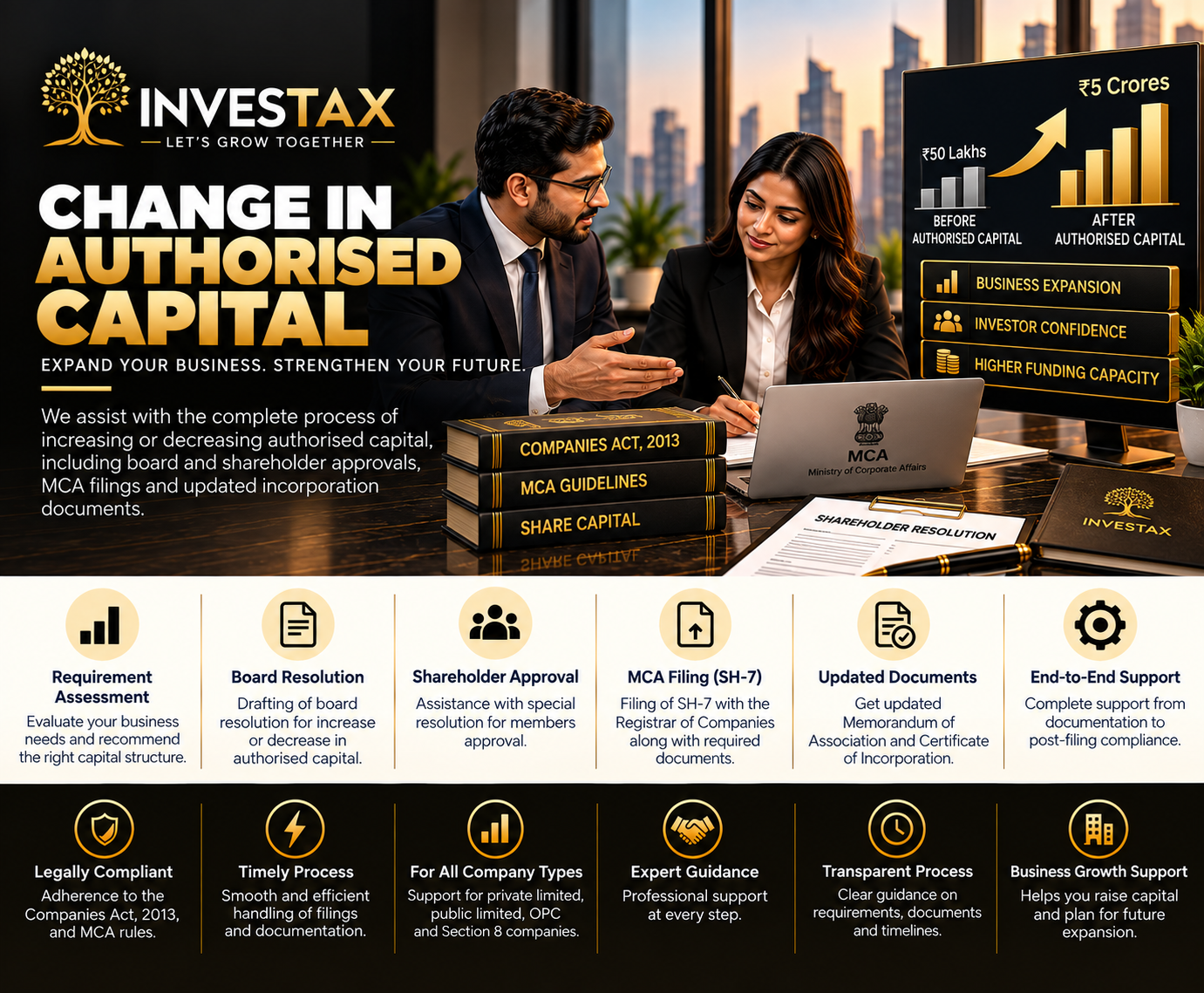
Investax India assists companies with changes in authorised share capital, including capital requirement assessment, Board and shareholder approvals, MGT-14 and SH-7 filings, updated corporate documents and post-filing compliance.
Change in Authorised Capital
As a company grows, its existing authorised share capital may no longer be sufficient to support its future plans. A company may therefore need to increase its authorised share capital before issuing additional shares or undertaking certain capital restructuring activities.
Changing authorised capital is a formal corporate action and requires compliance with the Companies Act, 2013, the company's Articles of Association and applicable MCA filing requirements.
Investax India provides end-to-end assistance for changing authorised share capital, including requirement assessment, corporate approvals, resolutions, MCA filings, SH-7, applicable MGT-14 filing and updating the company's statutory records.
What Is Authorised Share Capital?
Authorised share capital is the maximum amount of share capital that a company is authorised to issue as specified in its Memorandum of Association.
It represents the upper limit of share capital that the company can issue unless its authorised capital is increased through the applicable corporate and statutory process.
Authorised capital should not be confused with issued, subscribed or paid-up share capital. These represent different aspects of a company's share capital structure.
Why Change Authorised Capital?
A company may need to increase its authorised capital for several business and corporate reasons.
- Issuing additional shares
- Bringing in new investors
- Raising additional equity capital
- Increasing promoter shareholding
- Expanding the company's capital structure
- Issuing shares to new shareholders
- Supporting business expansion
- Preparing for a future fundraising round
- Converting or restructuring certain capital arrangements
- Aligning authorised capital with the company's future requirements
Authorised Capital vs Paid-Up Capital
| Particular | Authorised Capital | Paid-Up Capital |
|---|---|---|
| Meaning | Maximum share capital the company is authorised to issue | Amount of share capital actually paid by shareholders against shares issued |
| Purpose | Sets the ceiling for issuing shares | Represents capital actually subscribed and paid |
| Can it be increased? | Yes, subject to applicable provisions and approvals | Yes, through an applicable share issue or capital transaction |
| MCA compliance | Relevant alteration and filing requirements apply | Relevant allotment and other applicable filings apply |
When Should a Company Increase Authorised Capital?
A company should consider increasing its authorised capital when its proposed share issuance would exceed the existing authorised capital limit.
For example, if a company currently has authorised share capital of ₹10 lakh and plans to issue shares that would require a higher authorised capital limit, the company may first need to increase its authorised capital through the applicable statutory process.
The exact requirement should be reviewed based on the company's existing capital structure and proposed transaction.
Increase in Authorised Share Capital
Section 61 of the Companies Act, 2013 provides the statutory framework for alteration of share capital in applicable circumstances.
Subject to the applicable provisions, a company may increase its authorised share capital by following the required corporate approval process and filing the prescribed forms with the Registrar of Companies.
The company's Articles of Association should also be reviewed before proceeding with the alteration.
Procedure for Increasing Authorised Capital
Step 1 – Review Existing Capital Structure
We review the company's existing authorised, issued, subscribed and paid-up share capital and understand the proposed capital requirement.
Step 2 – Check the Articles of Association
The Articles of Association are reviewed to determine whether they contain the necessary authority for alteration of the authorised share capital.
Where required, the Articles may need to be amended before or along with the proposed capital alteration.
Step 3 – Board Meeting
The Board considers the proposed increase in authorised share capital and approves the necessary corporate actions, including convening the required members' meeting where applicable.
Step 4 – Members' Approval
The company obtains the required approval of its members through the applicable resolution process.
Step 5 – MGT-14 Filing, Where Applicable
Where a resolution is required to be filed with the Registrar, the company completes the applicable MGT-14 filing and obtains the relevant Service Request Number.
Step 6 – File Form SH-7
The company files Form SH-7 with the Registrar of Companies to report the applicable alteration of share capital.
MCA's SH-7 instruction kit specifically provides for reporting an increase in authorised share capital and requires the relevant revised authorised capital details to be entered in the form. :contentReference[oaicite:1]{index=1}
Step 7 – Pay Applicable Fees and Stamp Duty
The applicable MCA filing fee and stamp duty, where applicable, are determined based on the relevant capital alteration and jurisdictional requirements.
Step 8 – Update Corporate Records
Following completion of the filing, the company should update its statutory records and relevant corporate documents to reflect the revised authorised capital.
What Is Form SH-7?
Form SH-7 is an MCA webform used for giving notice to the Registrar of certain alterations of share capital.
MCA's SH-7 instruction kit states that under Section 64(1) of the Companies Act, 2013 read with Rule 15 of the Companies (Share Capital and Debentures) Rules, 2014, the company is required to file the relevant return with the Registrar within 30 days of the alteration or increase in the circumstances covered by the form. :contentReference[oaicite:2]{index=2}
What Is MGT-14?
MGT-14 is an MCA filing used for registration of specified resolutions and agreements with the Registrar.
Where the applicable resolution relating to alteration of authorised share capital requires filing, the company completes the MGT-14 process before proceeding with the corresponding SH-7 filing.
The exact filing requirement depends on the type of company, resolution and applicable provisions.
Is a Special Resolution Required?
The requirement for a special resolution depends on the applicable provision and the nature of the capital alteration.
For an increase in authorised share capital under the applicable provisions of Section 61, the company should follow the prescribed corporate approval process and ensure that its Articles of Association authorise the alteration.
The exact resolution and filing requirements should be determined based on the company's structure and Articles.
Can Authorised Capital Be Increased Without Increasing Paid-Up Capital?
Yes. Increasing authorised capital does not by itself mean that the company has issued new shares or received additional funds from shareholders.
The authorised capital represents the maximum capital the company is permitted to issue. Actual issuance of shares and increase in paid-up capital are separate corporate actions.
Does Increasing Authorised Capital Mean Raising Money?
No.
An increase in authorised capital increases the company's permitted share capital ceiling. Money is raised only when shares are actually issued and subscribed for in accordance with the applicable provisions.
Authorised Capital and New Share Issue
Companies planning to issue additional shares should first review whether their existing authorised capital is sufficient for the proposed issue.
If the proposed issue would exceed the authorised capital, the company may need to increase its authorised capital before completing the relevant share issuance process.
Authorised Capital for Fundraising
Startups and growing companies often review their authorised capital before fundraising.
Before issuing shares to investors, the company should assess its existing authorised capital, proposed issue size, shareholding structure and the applicable share-issue compliance requirements.
Increasing authorised capital is only one part of the overall fundraising process and does not itself constitute an allotment of shares.
Authorised Capital for Bringing in New Investors
If a company intends to issue additional equity shares to new investors, it may first need sufficient authorised capital to accommodate the proposed issue.
The company should separately evaluate the applicable provisions relating to private placement, preferential issue, rights issue or another applicable mode of share issuance.
Can Authorised Capital Be Decreased?
A reduction or alteration of share capital is legally different from simply increasing authorised capital.
Depending on the proposed transaction, different provisions, approvals and procedures may apply. A company should therefore not assume that the process for increasing authorised capital can simply be reversed to reduce it.
The exact legal route should be determined based on the proposed capital restructuring.
Change in Authorised Capital and Memorandum of Association
The authorised share capital and share structure are reflected in the company's Memorandum of Association.
When authorised capital is altered, the relevant capital clause of the Memorandum should be updated as required under the applicable provisions and filing process.
Documents Required for Change in Authorised Capital
The exact documents depend on the company's circumstances and the applicable MCA filing. Common documents may include:
- Existing Memorandum of Association
- Existing Articles of Association
- Board resolution
- Notice of general meeting
- Explanatory statement, where applicable
- Members' resolution
- Meeting minutes
- Updated capital clause
- MGT-14 filing details, where applicable
- SH-7 filing information
- Other supporting documents required by MCA
Government Fees and Stamp Duty
Increasing authorised capital can involve additional MCA filing fees and applicable stamp duty.
The amount depends on the capital alteration, the company's jurisdiction and the applicable fee and stamp-duty structure.
Investax India can help identify the applicable statutory charges before filing.
Change in Authorised Capital for Private Limited Company
Private Limited Companies frequently increase authorised capital before issuing additional shares to promoters, investors or other eligible persons.
The company should review its Articles, obtain the appropriate approvals and complete the required MCA filings before proceeding with an issue that exceeds its existing authorised capital.
Change in Authorised Capital for Public Limited Company
Public Limited Companies can alter their authorised capital subject to the applicable provisions of the Companies Act, their constitutional documents and MCA requirements.
Additional governance and disclosure considerations may apply depending on the nature of the proposed transaction.
Change in Authorised Capital for OPC
An OPC may alter its authorised share capital subject to the applicable provisions and MCA filing requirements.
The proposed capital change should be evaluated based on the company's structure and the nature of the proposed transaction.
Change in Authorised Capital for Section 8 Company
Section 8 Companies are governed by specific provisions concerning their objects, capital and corporate structure.
Any proposed alteration of capital should therefore be reviewed in light of the applicable provisions and the company's particular circumstances.
Common Mistakes in Authorised Capital Increase
- Increasing authorised capital without checking the Articles of Association
- Confusing authorised capital with paid-up capital
- Failing to pass the required corporate resolution
- Incorrectly calculating the revised authorised capital
- Entering incorrect share-class details in SH-7
- Missing the applicable filing timeline
- Failing to complete MGT-14 where applicable
- Not updating the Memorandum of Association
- Ignoring applicable MCA fees and stamp duty
- Assuming that increasing authorised capital automatically increases paid-up capital
Post-Filing Compliance
After the authorised capital change is completed, the company should review and update its relevant corporate records.
- MCA company master data
- Memorandum of Association
- Statutory registers
- Share capital records
- Corporate records and minutes
- Accounting records
- Share issue documentation, where applicable
- Investor documentation, where applicable
Why Choose Investax India for Authorised Capital Change?
- Capital Requirement Assessment: Assistance in understanding the proposed capital requirement.
- Corporate Compliance: Guidance on the applicable approvals and resolutions.
- MCA Filing Support: Assistance with MGT-14 and SH-7 where applicable.
- Documentation Support: Assistance with resolutions and supporting documents.
- Updated Corporate Records: Guidance on updating the relevant statutory documents.
- Transparent Process: Clear information regarding documents, government fees and filing requirements.
- End-to-End Assistance: Support from initial assessment through post-filing compliance.
Who Can Use Our Authorised Capital Change Services?
- Private Limited Companies
- Public Limited Companies
- One Person Companies
- Section 8 Companies, subject to applicable requirements
- Startups
- Growing businesses
- Companies preparing for fundraising
- Companies planning additional share issuance
- Businesses restructuring their capital
Frequently Asked Questions
1. What is authorised share capital?
Authorised share capital is the maximum share capital that a company is authorised to issue as specified in its Memorandum of Association.
2. Why does a company increase authorised capital?
A company may increase authorised capital when it needs a higher permitted capital limit, such as before issuing additional shares to promoters, investors or other shareholders.
3. Which form is used to increase authorised capital?
Form SH-7 is used for reporting the applicable alteration of share capital to the Registrar. MCA's SH-7 instructions specifically provide for reporting an increase in authorised share capital. :contentReference[oaicite:3]{index=3}
4. What is the time limit for filing SH-7?
MCA's SH-7 instruction kit states that the relevant return is to be filed with the Registrar within 30 days of the alteration or increase covered by the form. :contentReference[oaicite:4]{index=4}
5. Is MGT-14 required for increase in authorised capital?
MGT-14 may be required where the applicable resolution is one that must be registered with the Registrar. The exact requirement depends on the company and the resolution involved.
6. Does authorised capital increase automatically increase paid-up capital?
No. Increasing authorised capital only increases the maximum capital the company is permitted to issue. Paid-up capital increases when shares are actually issued and subscribed for.
7. Can authorised capital be increased before fundraising?
Yes. Companies may increase their authorised capital in preparation for a proposed share issue, provided the applicable corporate and statutory requirements are completed.
8. Can a company issue shares above its authorised capital?
A company should not issue shares beyond its authorised capital limit. Where additional authorised capital is required, the company should complete the applicable capital alteration process before proceeding with the relevant issue.
9. Does the Articles of Association need to be checked?
Yes. The company's Articles should be reviewed because the authority and procedure for alteration of authorised capital depend partly on the company's constitutional documents and applicable law.
10. Does the Memorandum of Association need to be updated?
The relevant capital clause of the Memorandum should be updated as required following the alteration of authorised capital.
11. Is shareholder approval required?
The applicable member approval depends on the statutory provision and the company's constitutional documents. The appropriate resolution process should be followed before filing.
12. Is there a government fee for increasing authorised capital?
Yes. Applicable MCA filing fees and stamp duty may arise depending on the amount of capital being altered and the applicable jurisdictional fee structure.
13. Can authorised capital be increased and shares issued on the same day?
Multiple corporate actions may be completed within the same overall transaction, but each action must satisfy its own applicable approval and filing requirements.
14. Can authorised capital be reduced?
Certain forms of capital reduction are governed by different statutory provisions and procedures. A reduction should not be treated as the same process as an increase in authorised capital.
15. Does increasing authorised capital mean the company has raised funds?
No. Authorised capital is only the permitted ceiling. Funds are raised when shares are actually issued and subscribed for.
16. Can a startup increase authorised capital before receiving investment?
Yes, subject to the company's requirements and applicable corporate and MCA procedures.
17. What documents are required?
Common documents include the company's Memorandum and Articles, resolutions, meeting documents, MGT-14 details where applicable and information required for SH-7.
18. How long does the complete process take?
The timeline depends on the company's documentation, approvals, MCA processing and the specific capital alteration. The applicable statutory filing deadline should be observed regardless of processing time.
19. Can Investax India handle the complete process?
Yes. Investax India can assist with capital requirement assessment, corporate documentation, resolutions, applicable MCA filings and post-filing compliance.
Increase Your Capital Structure With the Right Compliance
Changing authorised capital is an important corporate action, particularly when a company is preparing for additional share issuance, fundraising or business expansion.
Investax India helps companies manage the complete authorised capital alteration process, from assessing the requirement and preparing corporate documents to completing applicable MCA filings and updating statutory records.
Plan your capital. Complete your filings. Prepare your company for the next stage of growth.
Need help with Change in Authorised Capital?
Get practical guidance on requirements, documentation, compliance and the right service for your needs.