
Income Tax
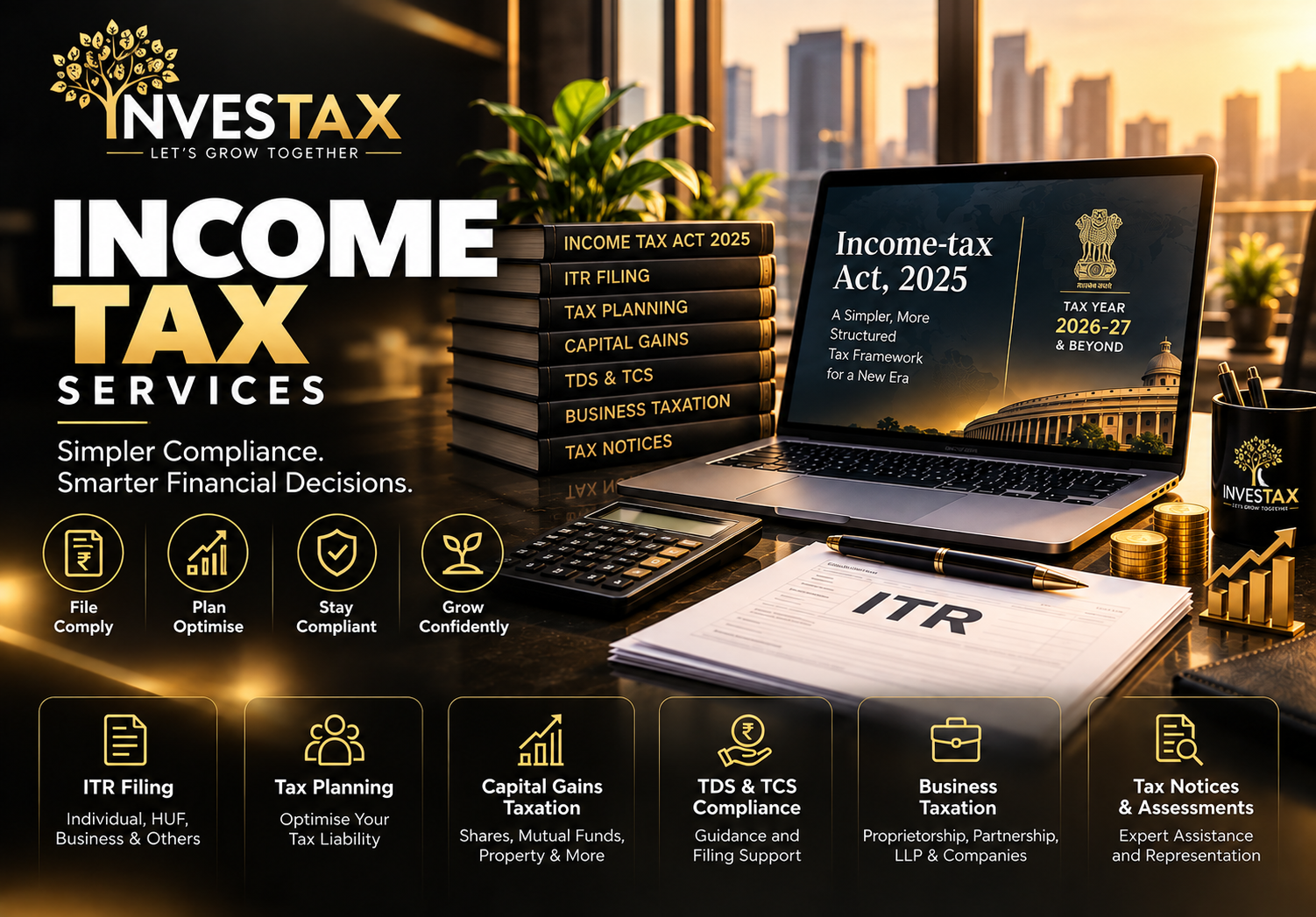
Managing income tax can involve much more than simply filing an Income Tax Return. From tax planning and return filing to capital gains, TDS compliance, tax notices and assessments, proper tax management helps you stay compliant while making informed financial decisions.
Should I choose Old or New Tax Regime?
Compare an indicative tax outcome using your taxable income and eligible old-regime deductions.
Indicative comparison only. Special-rate income, surcharge, rebates/reliefs, business/profession rules and other facts can change the result. Verify the applicable tax year and rules before filing.
Income Tax
Income Tax is an important part of personal financial planning, business compliance and investment management. Whether you are a salaried individual, professional, investor, entrepreneur, HUF, partnership firm, LLP or company, understanding your income tax obligations can help you remain compliant and make better financial decisions.
At Investax India, we provide comprehensive Income Tax services covering Income Tax Return filing, tax planning, capital gains taxation, TDS and TCS compliance, business taxation, tax assessments and assistance with Income Tax notices.
Our services are designed around the applicable provisions of the Income-tax Act and Income-tax Rules, with particular attention to the transition from the Income-tax Act, 1961 to the Income-tax Act, 2025.
Income-tax Act, 2025 – India's New Income Tax Law
The Income-tax Act, 2025 is the new legislation governing income taxation in India from 1 April 2026. It replaces the Income-tax Act, 1961 and introduces a more streamlined and reorganised framework for income-tax law.
The new Act has been introduced with the objective of simplifying the language and structure of income-tax law, consolidating provisions, reducing unnecessary complexity and making the legislation easier for taxpayers and professionals to understand.
The Income-tax Act, 2025 contains 536 sections and 16 schedules. Several provisions that were previously spread across sections, provisos and explanations have been reorganised into a more structured format. Tables and formulas have also been used in various provisions to make certain rules easier to follow.
The new Act does not create a separate new category of income tax merely because the legislation has changed. Instead, it substantially restructures and consolidates the existing income-tax framework while introducing updated terminology and provisions.
What Does the Income-tax Act, 2025 Cover?
The Income-tax Act, 2025 provides the legislative framework for taxation of income and related compliance in India. It covers various aspects of taxation, including computation of income, tax liability, deductions, exemptions, return filing, tax collection, assessments, appeals, penalties and other compliance requirements.
The major areas covered by the income-tax framework include:
- Taxability of income earned by individuals and other taxpayers
- Residential status and its relevance to taxation
- Computation of taxable income
- Income from employment and other sources
- Income from house property
- Business and professional income
- Capital gains arising from investments and assets
- Income from other sources
- Deductions and applicable tax benefits
- Tax rates, surcharge and applicable cess
- Tax Deducted at Source (TDS)
- Tax Collected at Source (TCS)
- Advance tax and self-assessment tax
- Income Tax Return filing
- Belated, revised and updated returns
- Assessment and reassessment-related provisions
- Interest, fees and penalties
- Appeals and tax dispute procedures
- International taxation and cross-border transactions
- Taxation and reporting of specified financial transactions and assets
From Assessment Year to Tax Year
One of the important terminology changes introduced by the Income-tax Act, 2025 is the replacement of the traditional Assessment Year terminology with the concept of a Tax Year.
A Tax Year is a twelve-month period beginning on 1 April. For example, Tax Year 2026-27 refers to the period beginning on 1 April 2026 and ending on 31 March 2027.
This change is intended to make the tax period easier to understand because the period in which income is earned and the period referred to for tax compliance are more closely aligned under the new terminology.
Transition from Income-tax Act, 1961 to Income-tax Act, 2025
The transition to the new law does not mean that all earlier tax matters suddenly move to the Income-tax Act, 2025. The applicable law depends on the period to which the income or proceeding relates.
Income for FY 2025-26
Income earned during Financial Year 2025-26 is governed by the Income-tax Act, 1961 and is reported through the applicable Assessment Year 2026-27 return.
Income from FY 2026-27 onwards
Income earned from 1 April 2026 onwards falls under the framework of the Income-tax Act, 2025 and is dealt with using the Tax Year concept.
Earlier assessments, returns, appeals and other proceedings relating to periods governed by the Income-tax Act, 1961 continue under the applicable provisions of the old law in accordance with the transition and savings provisions.
Major Areas of Income Tax Compliance
Income Tax Return Filing
Preparation and filing of Income Tax Returns for individuals, salaried taxpayers, professionals, HUFs, businesses, firms, LLPs and companies, based on the applicable tax provisions and nature of income.
Tax Planning
Tax planning assistance to understand applicable deductions, exemptions, tax regimes and investment-related tax implications while maintaining compliance with applicable law.
Capital Gains Tax
Assistance in determining and reporting taxable gains arising from the sale or transfer of shares, mutual funds, securities, property and other capital assets.
Business & Professional Taxation
Income-tax compliance and advisory support for proprietorships, professionals, partnership firms, LLPs and companies.
TDS & TCS Compliance
Assistance with applicable Tax Deducted at Source and Tax Collected at Source requirements, including compliance, reporting and related tax matters.
Tax Notices & Assessments
Assistance in understanding Income Tax communications, responding to notices and handling applicable assessment and compliance requirements.
Income Tax Return Filing Under the New Act
The Income-tax Act, 2025 consolidates provisions relating to filing of returns into Section 263. The framework covers original returns, belated returns, revised returns and updated returns.
The new framework continues to require eligible taxpayers to file returns and provides mechanisms for correcting or updating information, subject to the applicable conditions and statutory time limits.
For Tax Year 2026-27 and subsequent years, taxpayers will need to follow the return filing procedures and forms prescribed under the new Act and the Income-tax Rules, 2026.
Tax Planning Under the New Income Tax Framework
Effective tax planning involves understanding your sources of income, investments, deductions, exemptions, applicable tax regime and long-term financial objectives.
Tax planning should not be limited to reducing tax payable. It should also consider cash-flow requirements, investment decisions, business structure, compliance obligations and the tax consequences of future transactions.
Investax India helps taxpayers evaluate their income and financial transactions to understand applicable tax implications and plan their tax affairs within the framework of the law.
Capital Gains and Investment Taxation
Investments can create different tax implications depending on the nature of the asset, date and manner of acquisition, date of transfer and applicable provisions.
Our Income Tax services can assist with the tax reporting of capital gains arising from investments such as shares, mutual funds, securities, property and other capital assets.
Accurate computation and reporting of capital gains is particularly important for taxpayers with multiple investments or transactions during the tax year.
Income Tax Services for Businesses
Businesses have additional income-tax responsibilities depending on their legal structure, nature of operations, turnover, accounting records and applicable compliance requirements.
Investax India provides Income Tax assistance for:
- Proprietorship Businesses
- Partnership Firms
- Limited Liability Partnerships
- Private Limited Companies
- Public Limited Companies
- Professionals and Self-Employed Persons
- Start-ups and Growing Businesses
TDS, TCS and Advance Tax Compliance
Income Tax compliance is not limited to filing an annual return. Depending on the nature of income and transactions, taxpayers and businesses may also have obligations relating to TDS, TCS and advance tax.
Proper tracking of tax deducted or collected, tax credits and advance tax payments helps reduce discrepancies between financial records, tax statements and the Income Tax Return.
Income Tax Notices and Assessments
Taxpayers may receive communications or notices from the Income Tax Department for different reasons, including verification of information, clarification of transactions, defective returns, assessment proceedings or other compliance matters.
A tax notice should be reviewed carefully and responded to within the applicable time limit. Investax India can assist in understanding the communication, preparing the required response and organising the supporting information.
Who Can Use Our Income Tax Services?
- Salaried Individuals
- Professionals and Consultants
- Freelancers and Self-Employed Persons
- Investors
- HUFs
- Proprietors
- Partnership Firms
- LLPs
- Private Limited Companies
- Public Limited Companies
- Start-ups and Growing Businesses
- Taxpayers dealing with Income Tax Notices or Assessments
Why Choose Investax India for Income Tax Services?
Income Tax requirements can vary significantly depending on your income sources, investments, business structure and transactions. A structured approach helps ensure that relevant income is reported correctly and applicable compliance requirements are addressed on time.
Investax India combines Income Tax compliance, tax planning and financial understanding to provide practical assistance to individuals and businesses.
- Income Tax Return Filing
- Tax Planning and Advisory
- Capital Gains Computation
- Business Tax Compliance
- TDS and TCS Assistance
- Tax Notice Assistance
- Assessment and Compliance Support
Stay Compliant. Plan Better. Grow Smarter.
The transition to the Income-tax Act, 2025 represents a significant restructuring of India's income-tax legislation. Understanding the applicable provisions and keeping accurate records can help taxpayers manage their tax responsibilities more effectively.
Whether you need to file your Income Tax Return, understand capital gains, plan your taxes, manage business taxation or respond to an Income Tax notice, Investax India can help you navigate the applicable tax and compliance requirements.
Connect with Investax India for Income Tax Filing, Tax Planning and Compliance Services.
Frequently Asked Questions About Income Tax
1. What is the Income-tax Act, 2025?
The Income-tax Act, 2025 is India's new income-tax legislation that replaces the Income-tax Act, 1961. It provides the legal framework for taxation of income and related matters from 1 April 2026, subject to applicable transition provisions.
2. Why was the Income-tax Act, 2025 introduced?
The new Act was introduced to simplify and reorganise India's income-tax law, improve readability, consolidate provisions and reduce unnecessary complexity in the tax legislation.
3. Does the Income-tax Act, 2025 introduce a new tax?
The new Act itself does not impose a new tax merely because the legislation has changed. Its primary purpose is to restructure, consolidate and simplify the income-tax framework while incorporating applicable tax provisions.
4. When does the Income-tax Act, 2025 come into effect?
The Income-tax Act, 2025 comes into effect from 1 April 2026. The transition provisions ensure continuity for earlier tax years and ongoing proceedings.
5. What is a Tax Year under the Income-tax Act, 2025?
A Tax Year is generally a twelve-month period corresponding to the financial year beginning on 1 April and ending on 31 March. For example, Tax Year 2026-27 refers to the period from 1 April 2026 to 31 March 2027.
6. What happened to the Assessment Year under the new Act?
The Income-tax Act, 2025 discontinues the Assessment Year terminology for the new framework and introduces the Tax Year concept. Earlier years continue to be dealt with under the applicable provisions and transition rules.
7. Which Act applies to FY 2025-26?
Income earned during FY 2025-26 continues to be governed by the Income-tax Act, 1961 and is generally reported for Assessment Year 2026-27.
8. Which Act applies to income earned from 1 April 2026?
Income earned from 1 April 2026 onwards is generally governed by the Income-tax Act, 2025. The period from 1 April 2026 to 31 March 2027 is referred to as Tax Year 2026-27.
9. Who needs to file an Income Tax Return?
The requirement to file an Income Tax Return depends on the taxpayer's income, applicable thresholds, nature of income and other conditions prescribed under the applicable tax law. Certain taxpayers may also have filing obligations because of specified transactions or circumstances.
10. Can salaried individuals file an Income Tax Return?
Yes. Salaried individuals may need to file an Income Tax Return depending on their income and circumstances. Filing may also be useful for reporting additional income, claiming eligible refunds and maintaining proper tax records.
11. How are capital gains taxed?
Capital gains taxation depends on the nature of the asset, the transaction, applicable holding-period rules, cost and other provisions applicable to the relevant tax period.
12. Do I need to report capital gains from shares and mutual funds?
Taxable transactions involving shares, mutual funds and other investments generally need to be appropriately reported in the Income Tax Return. The applicable computation and tax treatment depend on the nature of the investment and the relevant tax provisions.
13. What is TDS?
TDS stands for Tax Deducted at Source. Under specified provisions, tax may be deducted by the payer from certain payments and deposited with the government. The tax deducted can generally be reflected in the recipient's tax records and considered while determining the final tax liability.
14. What is TCS?
TCS stands for Tax Collected at Source. Under specified provisions, the person responsible for collecting certain amounts may be required to collect tax at source and deposit it with the government.
15. What is advance tax?
Advance tax is tax paid during the relevant tax year instead of paying the entire tax liability after the end of the year. Taxpayers to whom the advance-tax provisions apply are required to pay it according to the prescribed provisions and instalments.
16. What should I do if I receive an Income Tax notice?
An Income Tax notice should be reviewed carefully to understand the reason for the communication, information requested and applicable response deadline. Depending on the notice, documents or an online response may be required.
17. Can Investax India help with Income Tax notices?
Yes. Investax India can assist in understanding Income Tax communications, organising relevant information and preparing an appropriate response, depending on the nature and scope of the matter.
18. Can Investax India help with Income Tax Return filing?
Yes. Investax India provides Income Tax Return filing assistance for individuals, professionals, HUFs, businesses, firms and companies, depending on their applicable tax and compliance requirements.
19. Can Investax India help with business Income Tax compliance?
Yes. Investax India provides Income Tax assistance for proprietorships, partnership firms, LLPs and companies, including applicable return filing, tax computation and other Income Tax compliance requirements.
20. What documents are generally required for Income Tax Return filing?
Requirements vary depending on the taxpayer and sources of income. Common information may include Form 16, Form 16A where applicable, bank statements, interest certificates, investment statements, capital-gains statements, deduction details and other relevant financial records.
21. Is tax planning the same as tax evasion?
No. Legitimate tax planning involves arranging financial affairs in accordance with applicable law and using legally available deductions, exemptions and provisions. Tax evasion is unlawful and is fundamentally different from legitimate tax planning.
22. Why should I take professional assistance for Income Tax?
Income Tax compliance can involve multiple sources of income, investments, deductions, TDS credits, capital gains and reporting requirements. Professional assistance can help organise information, identify applicable requirements and reduce avoidable errors.
Need help with Income Tax?
Get practical guidance on requirements, documentation, compliance and the right service for your needs.