
Winding Up of Company
Investax India assists companies in evaluating the appropriate closure route, including voluntary liquidation where applicable and strike-off of the company's name from the Register of Companies, along with the required documentation, approvals, MCA/ROC filings and closure-related compliance.
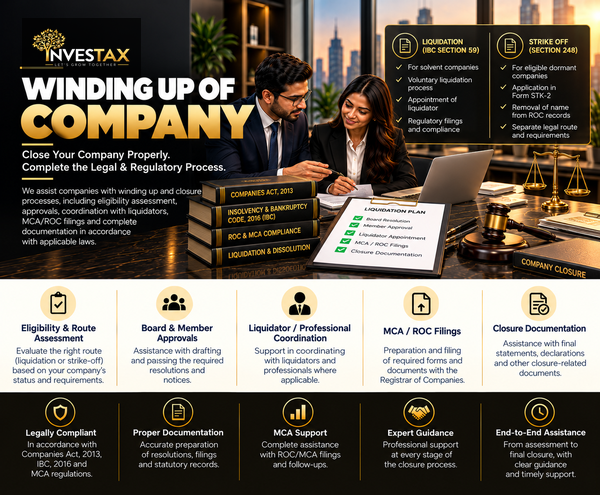
Winding Up of Company – Liquidation & Closure Services
When a company is no longer required to continue its business, simply stopping operations does not automatically close the company. The company may need to complete the appropriate legal, financial, tax and corporate compliance process before it can be formally closed.
Investax India assists companies in evaluating the appropriate closure route, including voluntary liquidation where applicable and strike-off of the company's name from the Register of Companies, along with the required documentation, approvals, MCA/ROC filings and closure-related compliance.
What is Winding Up of a Company?
Winding up is the process of bringing the affairs of a company to an end, dealing with its assets and liabilities, settling applicable obligations and ultimately completing the legal process through which the company's existence is brought to an end.
The appropriate closure mechanism depends on the company's financial position, liabilities, assets, business status, pending compliance and the circumstances under which the company is being closed.
Under the present legal framework, companies should distinguish between voluntary liquidation under Section 59 of the Insolvency and Bankruptcy Code, 2016 and strike-off under Section 248 of the Companies Act, 2013.
Winding Up, Voluntary Liquidation and Strike-Off – What's the Difference?
| Particulars | Voluntary Liquidation | Strike-Off |
|---|---|---|
| Primary framework | Section 59 of the Insolvency and Bankruptcy Code, 2016 | Section 248 of the Companies Act, 2013 |
| Typical situation | Used by an eligible solvent corporate person seeking voluntary liquidation | Used where the company is eligible to have its name removed from the Register |
| Liquidator | An insolvency professional acts as liquidator | Generally follows the strike-off process rather than a voluntary liquidation process |
| Assets and liabilities | Liquidation process deals with the company's assets and liabilities | Company must satisfy the applicable strike-off conditions and requirements |
| Final outcome | Dissolution through the applicable voluntary liquidation process | Removal of the company's name from the Register of Companies |
The appropriate route should be determined after reviewing the company's circumstances rather than treating strike-off and liquidation as interchangeable procedures.
Voluntary Liquidation Under Section 59 of IBC
Section 59 of the Insolvency and Bankruptcy Code provides for voluntary liquidation of a corporate person that intends to liquidate voluntarily and meets the applicable requirements.
For a company, the process includes a declaration by the required majority of directors regarding the company's affairs and ability to meet its debts, along with the prescribed supporting financial information and valuation report where applicable.
The members then pass the required resolution for voluntary liquidation and appoint an insolvency professional to act as liquidator. Where the company owes debt, the prescribed creditor approval requirement also applies.
Who Can Consider Voluntary Liquidation?
Voluntary liquidation is generally relevant to a corporate person that is solvent and has not committed a default, subject to the detailed requirements of Section 59 and the applicable regulations.
The company should undertake a proper review of its assets, liabilities, creditors, statutory dues, tax matters, litigation, contracts and other obligations before commencing the process.
Declaration of Solvency
An important part of voluntary liquidation is the declaration by the required majority of directors.
The declaration includes confirmation, supported by the prescribed requirements, that the directors have made a full inquiry into the company's affairs and formed the required opinion regarding the company's debts and ability to pay them from the proceeds of assets to be sold during liquidation.
The directors must also declare that the company is not being liquidated to defraud any person.
Financial Statements and Asset Valuation
The prescribed voluntary liquidation process requires supporting financial information, including audited financial statements and records of business operations for the prescribed period.
Where applicable, a valuation report of the company's assets prepared by a registered valuer is also required.
Appointment of Liquidator
As part of the voluntary liquidation process, the members appoint an insolvency professional to act as the liquidator in accordance with Section 59 and the applicable regulations.
The liquidator is responsible for carrying out the liquidation process, dealing with the company's assets and liabilities, making distributions in accordance with applicable law and completing the required reporting and filings.
Approval of Creditors
Where the company owes debt to any person, the voluntary liquidation provisions contain specific requirements relating to approval by creditors representing the prescribed value of the company's debt.
Therefore, the company's creditor position should be reviewed before commencing voluntary liquidation.
Notification to ROC and IBBI
Section 59 also contains requirements for notifying the Registrar of Companies and the Insolvency and Bankruptcy Board of India regarding the resolution to liquidate the company voluntarily within the prescribed period.
The applicable filings and notifications should be completed carefully to ensure that the liquidation process proceeds in accordance with the statutory framework.
Liquidation of Company – Major Steps
1. Review the Company's Position
The first step is to review the company's assets, liabilities, creditors, statutory dues, tax position, bank accounts, investments, contracts and pending litigation.
2. Determine the Appropriate Closure Route
The company should determine whether voluntary liquidation, strike-off or another legally applicable route is appropriate based on its circumstances.
3. Prepare Financial and Corporate Records
The company should bring its financial statements, accounting records, statutory records and corporate compliance position up to date as required.
4. Obtain Required Declarations and Approvals
For voluntary liquidation, the required directors' declaration, members' resolution and other prescribed documentation must be completed.
5. Appoint the Liquidator
Where voluntary liquidation is undertaken under Section 59, an insolvency professional is appointed as liquidator in accordance with the applicable provisions.
6. Settle Assets and Liabilities
The liquidation process involves identifying and dealing with the company's assets and liabilities and completing distributions in accordance with applicable law.
7. Complete Statutory and Regulatory Filings
The required MCA, ROC, tax and other regulatory filings should be completed as applicable to the company and the chosen closure route.
8. Complete Dissolution / Closure
After completion of the applicable process, the liquidator or company proceeds with the final dissolution or removal of the company's name in accordance with the applicable legal route.
Strike-Off of Company Under Section 248
Strike-off is a separate mechanism through which the name of an eligible company can be removed from the Register of Companies.
The MCA provides Form STK-2 for an application by a company to the Registrar for removal of its name from the Register of Companies.
Strike-off is subject to eligibility conditions, restrictions and prescribed documentation. It should not be treated as an automatic alternative to liquidation where the company has unresolved liabilities or other circumstances that make it ineligible.
When May Strike-Off Be Considered?
Strike-off may be considered by an eligible company that has ceased operations or falls within the circumstances permitted under the applicable provisions and rules.
Before applying, the company should review outstanding liabilities, statutory dues, litigation, charges, bank accounts, tax registrations, pending filings and other obligations.
Form STK-2 for Company Closure
Form STK-2 is the MCA form used for an application by a company to the Registrar of Companies for removal of its name from the Register of Companies.
The current MCA instruction kit specifies eligibility and restriction checks for companies filing STK-2. For example, the instruction kit identifies certain categories of companies that cannot use the form, including listed companies and Section 8 companies.
Eligibility should always be checked against the company's current status and the applicable provisions before filing.
Documents Generally Required for Company Closure
- Certificate of Incorporation
- PAN and company identification details
- Memorandum and Articles of Association, where required
- Latest financial statements and accounting records
- Details of assets and liabilities
- Bank account details
- Details of directors and shareholders
- Details of creditors and outstanding liabilities
- Tax and statutory compliance information
- Board and members' resolutions, where applicable
- Directors' declarations and affidavits, where applicable
- Indemnity bond and other prescribed documents, where applicable
- Other documents required for the selected closure route
What Happens to Company Assets?
Company assets should be identified and dealt with according to the applicable closure mechanism.
Under voluntary liquidation, the liquidator undertakes the prescribed process for realising and distributing assets in accordance with applicable law and the order of distribution prescribed under the legal framework.
Assets should not simply be transferred to directors or shareholders without considering the applicable legal, tax and corporate requirements.
What Happens to Company Liabilities?
Outstanding liabilities should be identified and addressed before completing the company's closure.
These may include loans, trade creditors, employee dues, taxes, statutory liabilities, contractual obligations and other claims.
The treatment of liabilities depends on the applicable closure mechanism and the company's financial position.
What About GST, Income Tax and Other Registrations?
Closing a company does not automatically mean that every tax and regulatory obligation disappears.
Depending on the company's circumstances, GST registration, income-tax matters, TDS, professional tax, EPFO, ESIC, licences and other registrations may require separate closure, surrender or final compliance.
A proper closure checklist should therefore be prepared before the company is formally closed.
What Happens to the Company's Bank Account?
The company's bank accounts should be reviewed and dealt with as part of the closure process.
Outstanding balances, pending transactions, bank charges, deposits and other banking matters should be addressed before final closure, subject to the requirements of the applicable liquidation or strike-off process.
What About Pending Annual Filings?
Pending annual filings and other statutory defaults should be reviewed before applying for company closure.
The existence of pending compliance does not automatically mean that every company must follow the same route, but outstanding filings, penalties, statutory dues and other defaults can affect the closure process and should be assessed before filing.
Can a Company With Debts Be Closed?
A company with liabilities should not simply apply for closure without assessing the nature and status of those liabilities.
Voluntary liquidation under Section 59 has specific requirements relating to solvency and the company's ability to meet its debts. Where creditors or defaults are involved, the applicable insolvency and liquidation framework must be carefully examined.
Winding Up vs Strike-Off
Although the terms are sometimes used interchangeably in general business discussions, winding up, voluntary liquidation and strike-off are not identical processes.
Voluntary liquidation: A structured liquidation process for an eligible corporate person under Section 59 of the IBC.
Strike-off: A process for removal of an eligible company's name from the Register of Companies under the Companies Act.
Dissolution: The legal conclusion of the applicable process through which the corporate person's existence comes to an end.
Common Mistakes During Company Closure
- Choosing strike-off without checking eligibility
- Ignoring outstanding liabilities
- Failing to review pending statutory filings
- Ignoring tax and GST compliance
- Not checking outstanding charges
- Failing to address creditor claims
- Distributing company assets without following the applicable process
- Closing the bank account without considering pending transactions
- Using the wrong closure mechanism
- Failing to maintain proper corporate records
How Investax India Helps With Company Closure
- Initial company status and closure assessment
- Review of assets and liabilities
- Assessment of the appropriate closure route
- Strike-off eligibility review
- Voluntary liquidation process coordination
- Board and shareholder documentation assistance
- Liquidator coordination where applicable
- MCA and ROC filing assistance
- Tax and statutory compliance checklist
- Closure documentation and record management
- Post-closure compliance guidance
Why Choose Investax India?
Company closure is not simply about stopping business operations. A properly planned closure requires review of the company's legal status, financial position, statutory obligations, assets, liabilities and regulatory records.
Investax India helps businesses understand the applicable closure route and coordinate the documentation, approvals and compliance requirements involved in bringing the company to a proper legal conclusion.
Frequently Asked Questions – Winding Up of Company
1. Is winding up the same as strike-off?
No. Strike-off and liquidation are separate legal processes with different requirements and consequences. The appropriate route depends on the company's circumstances.
2. What is voluntary liquidation?
Voluntary liquidation is a liquidation process under Section 59 of the Insolvency and Bankruptcy Code, 2016 for an eligible corporate person that meets the prescribed conditions.
3. Can a solvent company voluntarily liquidate?
Yes, an eligible solvent corporate person may initiate voluntary liquidation under Section 59 of the IBC subject to the prescribed requirements.
4. What is Form STK-2?
STK-2 is the MCA form used by a company to apply to the Registrar of Companies for removal of its name from the Register of Companies.
5. Can every company apply for strike-off?
No. Strike-off is subject to statutory eligibility requirements and restrictions. The company's status and circumstances must be checked before filing.
6. Can a company with outstanding liabilities apply for closure?
The company's liabilities must be reviewed before choosing a closure route. Voluntary liquidation has specific solvency and creditor requirements, while strike-off also has statutory conditions and restrictions.
7. Is a liquidator required for voluntary liquidation?
Yes. Under Section 59, an insolvency professional is appointed to act as the liquidator for the voluntary liquidation process.
8. What happens to the company's assets during liquidation?
Assets are dealt with by the liquidator in accordance with the applicable liquidation framework, including realisation and distribution as prescribed by law.
9. What happens to creditors during company closure?
Creditors and outstanding liabilities must be properly identified and dealt with according to the applicable legal process. The treatment depends on the closure mechanism and the company's financial position.
10. Does company closure cancel GST registration automatically?
No. GST registration and other tax or regulatory registrations may require separate cancellation, surrender or final compliance depending on the circumstances.
11. Does closing the business automatically close the company?
No. Stopping business operations does not by itself remove the company from the legal register. The applicable statutory closure process must be completed.
12. Can a private limited company be closed?
Yes, subject to the applicable eligibility and legal requirements. The appropriate route may involve strike-off or another applicable liquidation or closure process.
13. Can an OPC be closed?
An OPC may be eligible for an applicable closure mechanism subject to the Companies Act, rules and its particular circumstances.
14. Can a Section 8 company use STK-2?
The MCA's current STK-2 instruction kit identifies Section 8 companies among the categories for which STK-2 is not permitted. The applicable alternative process should be assessed separately.
15. How long does company closure take?
The time required depends on the closure route, company records, outstanding compliance, liabilities, regulatory processing and other circumstances. No universal completion period should be assumed.
Get Assistance With Winding Up & Company Closure
If your company is no longer operating, the first step is to determine the correct legal closure route rather than simply leaving the company inactive.
Talk to Investax India for assistance with company closure, strike-off, voluntary liquidation, MCA/ROC compliance and related documentation.
Need help with Winding Up of Company?
Get practical guidance on requirements, documentation, compliance and the right service for your needs.