
Winding Up of LLP
Investax India assists LLPs with closure and winding-up requirements, including assessment of the appropriate closure route, partner approvals, documentation, settlement of assets and liabilities, MCA/ROC filings and Form 24 strike-off applications where applicable.
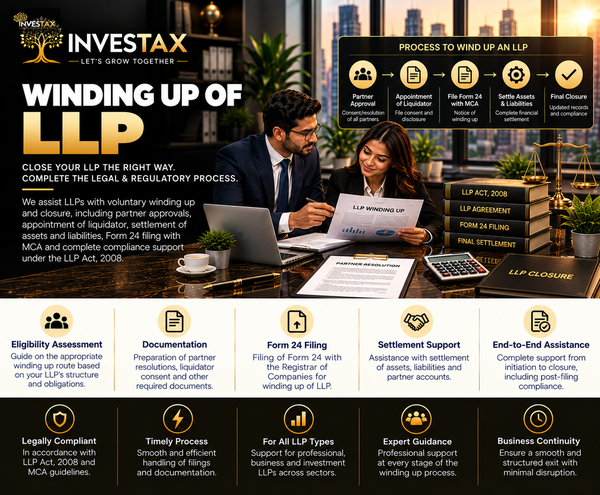
Winding Up of LLP – Closure & Form 24 Filing Services
When an LLP is no longer required or has stopped carrying on business, simply becoming inactive does not automatically close the LLP. The appropriate legal closure process should be completed so that the LLP's status, statutory records, assets, liabilities and regulatory obligations are properly addressed.
Investax India assists LLPs with closure and winding-up requirements, including assessment of the appropriate closure route, partner approvals, documentation, settlement of assets and liabilities, MCA/ROC filings and Form 24 strike-off applications where applicable.
What is Winding Up of an LLP?
Winding up is the legal process through which the affairs of an LLP are brought to an end, its assets and liabilities are dealt with and the LLP ultimately proceeds towards dissolution.
Section 63 of the Limited Liability Partnership Act, 2008 provides that winding up of an LLP may be voluntary or by the Tribunal, and an LLP so wound up may be dissolved.
The detailed winding-up framework is supported by the LLP (Winding up and Dissolution) Rules, 2012.
Winding Up vs Strike-Off of LLP
Winding up and strike-off are related to closure but should not be treated as identical processes.
| Particulars | Winding Up | Strike-Off |
|---|---|---|
| Legal framework | Sections 63–65 of the LLP Act and applicable winding-up rules | Section 75 of the LLP Act and Rule 37 of LLP Rules |
| Typical purpose | Formal process of winding up the affairs of the LLP | Removal of an eligible LLP's name from the Register |
| Form 24 | Not the general form for the entire winding-up process | Application for strike-off of eligible LLP |
| Assets and liabilities | Dealt with as part of the winding-up process | Eligibility requires the LLP to satisfy prescribed conditions before applying |
| Final outcome | Winding up followed by dissolution | Name removed from the Register after approval of the strike-off application |
The appropriate route should therefore be determined after reviewing the LLP's financial position, business activity, liabilities, compliance status and circumstances.
Voluntary Winding Up of LLP
An LLP may undertake voluntary winding up in accordance with the LLP Act and the applicable LLP (Winding up and Dissolution) Rules.
The process involves the required partner approvals, declaration of solvency where applicable, appointment of the liquidator and completion of the prescribed winding-up procedure.
The exact requirements depend on the circumstances of the LLP and the applicable provisions.
Winding Up by Tribunal
The LLP Act also provides for winding up by the Tribunal in specified circumstances.
Section 64 includes circumstances such as where the LLP decides that it should be wound up by the Tribunal, where the number of partners remains below two for more than six months, certain statutory defaults and where the Tribunal considers that it is just and equitable for the LLP to be wound up.
Tribunal winding-up is different from a routine voluntary closure or Form 24 strike-off and involves a separate legal process.
Strike-Off of LLP Through Form 24
For an eligible inactive LLP, strike-off may provide a route for removal of its name from the Register of LLPs.
MCA's current Form 24 instruction kit states that an LLP can apply to the Registrar with the consent of all partners for striking off its name where it has not carried on any business or operation for a period of one year or more, subject to the applicable requirements and restrictions.
Who Can Apply for LLP Strike-Off?
An LLP may consider Form 24 where it satisfies the prescribed conditions for strike-off.
The MCA's current Form 24 instructions require, among other things, that the LLP should not be carrying on business or operations for one year or more and that all partners consent to the application.
The LLP should also be checked for outstanding charges, pending filings, disputes, investigations, prosecutions and other restrictions before proceeding.
Important Form 24 Eligibility Checks
Before filing Form 24, the LLP should review its MCA master data and compliance status.
- The LLP should satisfy the prescribed inactivity requirement
- Consent of all partners is required for the application
- Open or unsatisfied charges can prevent filing
- Pending MCA forms or fee-related matters may affect filing eligibility
- Pending correction of LLP master data may affect filing
- A partner dispute marked on MCA records can prevent filing
- Pending inspection, investigation or prosecution may affect eligibility
- The LLP should have a valid and approved LLPIN
- Applicable income-tax compliance should be reviewed
- Bank account closure and financial records should be addressed as applicable
MCA's current Form 24 instruction kit contains the detailed eligibility and restriction checks and should be reviewed before filing.
Process for LLP Closure Through Form 24
1. Review the LLP Status
The first step is to review the LLP's MCA master data, business status, partners, designated partners, charges, pending forms and compliance history.
2. Determine Whether Strike-Off Is Appropriate
The LLP should determine whether it qualifies for strike-off or whether another winding-up or closure route is required.
3. Complete Pending Compliance
Where applicable, pending statutory filings, accounts, tax matters and other compliance issues should be addressed before applying for closure.
4. Settle Assets and Liabilities
The LLP should review its assets, bank balances, receivables, creditors, loans, taxes and other liabilities.
5. Close the Bank Account Where Applicable
Where the LLP has a bank account, the account should be dealt with appropriately and supporting bank documentation may be required for the closure application.
6. Obtain Partner Consent
The Form 24 strike-off application requires the consent of all partners.
7. Prepare Supporting Documents
The prescribed affidavits, indemnity documentation, financial statements, tax-related documents and other supporting documents should be prepared as applicable.
8. File Form 24 With MCA
The LLP Form 24 application is submitted to the Registrar of Companies through the MCA system along with the required supporting documentation.
9. ROC/MCA Examination
The Registrar examines the application and may issue notices or seek additional information or documents where required.
10. Strike-Off and Closure
Once the application is approved, the status of the LLP is changed to Strike off and its name is removed from the Register in accordance with the applicable process.
Documents Required for LLP Closure
- LLPIN and LLP master data
- Consent of all partners
- Partner details
- Statement of Accounts and Solvency, as applicable
- Affidavits and declarations as prescribed
- Indemnity documentation
- Latest income-tax return acknowledgement, where applicable
- Bank account closure certificate or statement, where applicable
- Details of assets and liabilities
- Details of pending statutory obligations
- Copy of LLP Agreement and amendments, where required
- Other documents prescribed for the selected closure route
What Happens to LLP Assets During Winding Up?
Assets of an LLP should be properly identified and dealt with as part of the applicable closure or winding-up process.
This may include bank balances, investments, receivables, fixed assets, intellectual property and other property belonging to the LLP.
Assets should not simply be distributed among partners without considering the applicable legal, accounting and tax requirements.
What Happens to LLP Liabilities?
The LLP's outstanding liabilities should be identified and settled or otherwise dealt with according to the applicable legal process.
These may include loans, trade creditors, employee dues, taxes, statutory liabilities and contractual obligations.
An LLP should not treat strike-off as a way to ignore legitimate outstanding liabilities.
What About Income Tax Compliance?
LLP closure does not automatically eliminate tax obligations.
The LLP's income-tax position, pending returns, assessments, tax demands, refunds and other matters should be reviewed before closure.
Where an income-tax return has been filed, the relevant acknowledgement may be required as part of the Form 24 documentation depending on the circumstances.
What About GST Registration?
If the LLP is registered under GST, GST compliance should be reviewed separately.
Depending on the circumstances, GST registration may require cancellation and final return or other applicable compliance before or in connection with closure.
Closing the LLP with MCA does not by itself mean that every separate tax or regulatory registration is automatically cancelled.
What Happens to the LLP Bank Account?
The LLP's bank account should be reviewed as part of the closure process.
Outstanding transactions, balances, deposits, charges and other banking matters should be resolved before final closure where applicable.
MCA's Form 24 framework also requires supporting evidence relating to bank account closure in applicable circumstances.
Can an LLP With Outstanding Liabilities Be Closed?
The presence of liabilities is an important factor when determining the appropriate closure route.
An LLP should first identify and address its creditors, statutory dues, tax obligations and other liabilities rather than assuming that a strike-off application is appropriate in every case.
Where a formal winding-up process is required, the applicable winding-up framework should be followed.
What If the LLP Has Not Started Business?
An LLP that has never commenced business may, subject to satisfying the applicable conditions, consider the prescribed strike-off route.
The MCA Form 24 instructions and applicable rules should be checked to determine the documentation required for the particular LLP.
What If the LLP Has Stopped Business?
An LLP that has ceased business may be eligible for strike-off if it satisfies the prescribed conditions.
MCA's current Form 24 instructions refer to an LLP that has not carried on business or operation for a period of one year or more, subject to the other eligibility requirements.
Difference Between LLP Closure and LLP Dissolution
Closure is commonly used as a general term for ending the LLP's operations, but legally there are different stages and mechanisms.
Winding up: The process of dealing with the LLP's affairs, assets and liabilities.
Strike-off: Removal of an eligible LLP's name from the Register under the applicable strike-off procedure.
Dissolution: The legal conclusion of the applicable winding-up process through which the LLP ceases to exist as a legal entity.
Common Reasons for Closing an LLP
- Business has permanently stopped
- LLP was created for a project that has ended
- Partners no longer wish to continue the business
- Business has become commercially unviable
- Partners have moved to another business structure
- LLP has remained inactive
- Business objectives have changed
- Partners have mutually decided to discontinue the LLP
Common Mistakes During LLP Closure
- Assuming inactivity automatically closes the LLP
- Using Form 24 without checking eligibility
- Ignoring pending annual filings
- Ignoring income-tax or GST obligations
- Leaving bank accounts open
- Ignoring outstanding liabilities
- Failing to obtain consent of all partners
- Ignoring open charges
- Failing to check pending MCA forms
- Not maintaining closure documentation
How Investax India Helps With LLP Closure
- LLP status and closure assessment
- Review of MCA master data
- Assessment of strike-off eligibility
- Winding-up route assessment
- Partner consent and documentation
- Financial and statutory compliance checklist
- Asset and liability review
- Form 24 preparation and filing
- MCA/ROC filing support
- Closure documentation
- Post-filing compliance guidance
Why Choose Investax India?
Closing an LLP requires more than stopping business operations. The LLP's legal status, assets, liabilities, tax position, partner records and MCA compliance should all be considered before the closure process is initiated.
Investax India helps LLPs evaluate the appropriate closure route and manage the documentation and MCA compliance involved in strike-off or winding-up, depending on the circumstances.
Frequently Asked Questions – Winding Up of LLP
1. Is winding up the same as LLP strike-off?
No. Winding up and strike-off are separate legal mechanisms. Winding up deals with bringing the affairs of the LLP to an end, while Form 24 is used for the prescribed strike-off process for an eligible LLP.
2. What is Form 24 for an LLP?
Form 24 is the MCA webform used by an eligible LLP to apply to the Registrar for striking off its name from the Register under Section 75 of the LLP Act read with Rule 37 of the LLP Rules.
3. Can an inactive LLP apply for strike-off?
Yes, subject to the prescribed conditions. MCA's current Form 24 instructions state that an LLP can apply where it has not carried on business or operation for one year or more, with the consent of all partners.
4. Is consent of all partners required for Form 24?
Yes. The current MCA Form 24 instructions state that the LLP can apply with the consent of all partners.
5. Can an LLP with outstanding charges file Form 24?
MCA's current Form 24 instructions state that filing is not allowed where there are open or unsatisfied charges against the LLP.
6. Can an LLP with pending investigation apply for Form 24?
The current MCA Form 24 instructions identify pending inspection, investigation or prosecution as matters that can affect eligibility for the filing.
7. What happens after Form 24 is approved?
MCA's current Form 24 instructions state that after approval, the status of the LLP is changed to “Strike off”.
8. Does LLP closure cancel GST automatically?
No. GST registration and other regulatory registrations may require separate cancellation or closure compliance depending on the circumstances.
9. What happens to LLP liabilities after closure?
Liabilities should be properly identified and dealt with according to the applicable legal process. Strike-off should not be treated as a substitute for addressing legitimate liabilities.
10. Can an LLP with no business apply for closure?
Yes, if it satisfies the applicable strike-off conditions and documentation requirements.
11. Is winding up by Tribunal different from voluntary closure?
Yes. Tribunal winding up is a separate legal process under the LLP Act and may arise in the circumstances specified in Section 64.
12. What documents are required for LLP closure?
Requirements depend on the closure route. They can include partner consent, financial statements, declarations, indemnity documentation, tax return acknowledgement, bank closure evidence and other prescribed documents.
13. How long does LLP closure take?
The time required depends on the closure route, completeness of records, outstanding compliance, MCA processing and whether any clarification or objection arises. No universal completion period should be assumed.
14. Can Investax India handle LLP Form 24 filing?
Yes. Investax India can assist with eligibility assessment, documentation, Form 24 preparation and filing, MCA/ROC compliance and related closure documentation.
Close Your LLP With Proper Compliance
If your LLP is no longer operating, do not simply leave it inactive. Determine the appropriate legal closure route and complete the required statutory process.
Talk to Investax India for LLP Closure, Winding Up, Form 24 Strike-Off and MCA Compliance Services.
Need help with Winding Up of LLP?
Get practical guidance on requirements, documentation, compliance and the right service for your needs.