
Remove Partner
A partner may cease to be a partner of an LLP in accordance with the LLP Agreement or, where the agreement does not provide for cessation, by following the statutory procedure under the LLP Act.
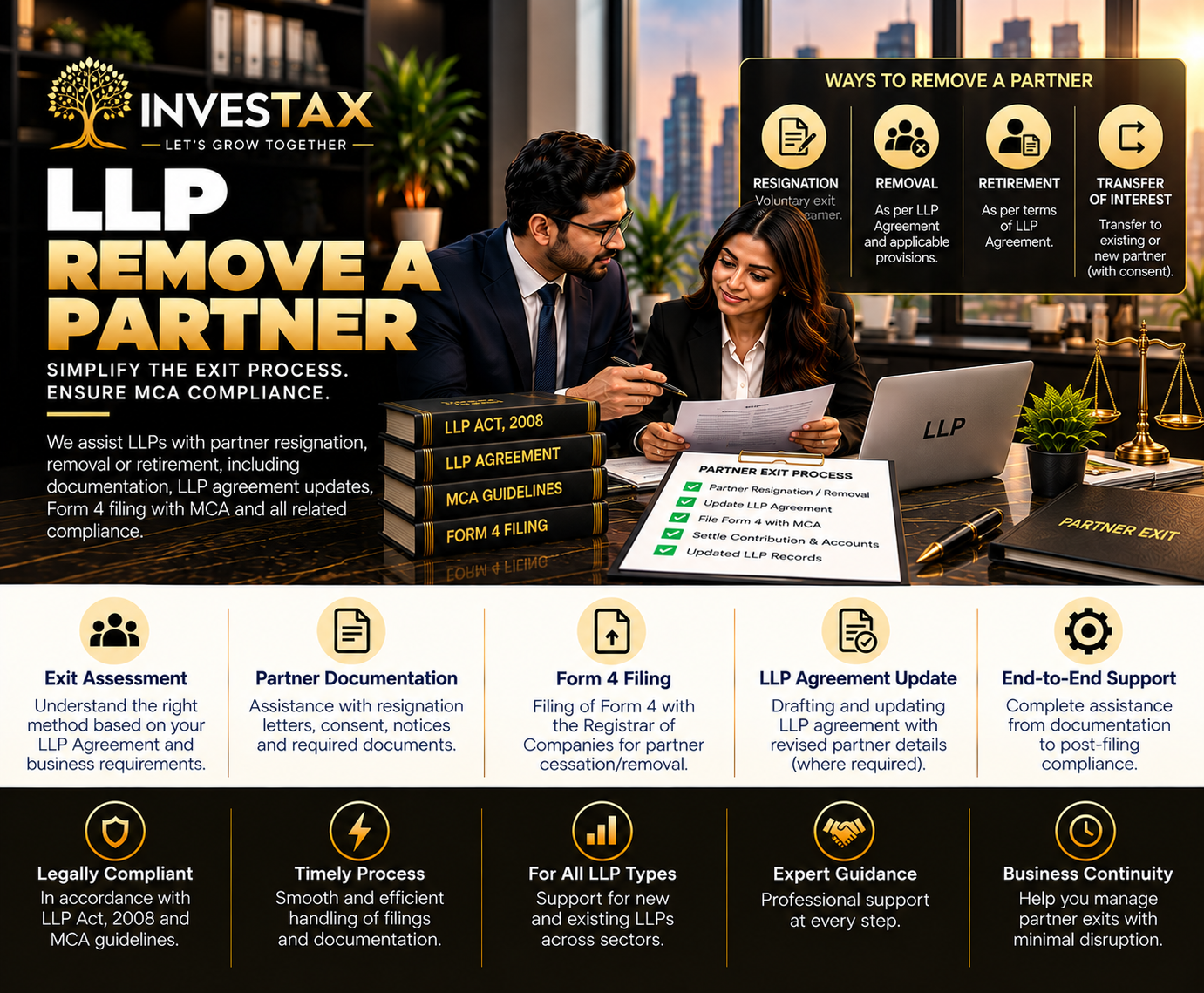
LLP Remove a Partner – Partner Resignation & MCA Filing Services
Removing a partner from a Limited Liability Partnership (LLP) requires proper documentation and timely statutory compliance. Whether a partner is resigning voluntarily, retiring, or otherwise ceasing to be associated with the LLP, the change should be handled in accordance with the LLP Agreement and the Limited Liability Partnership Act, 2008.
Investax India assists LLPs with partner exit and cessation, including resignation documentation, partner approvals, settlement of contribution and profit-sharing matters, LLP Agreement updates, Form 4 filing, linked Form 3 filing where applicable and related MCA compliance.
What Does Removal of a Partner From an LLP Mean?
A partner may cease to be a partner of an LLP in accordance with the LLP Agreement or, where the agreement does not provide for cessation, by following the statutory procedure under the LLP Act.
The reason for cessation may include resignation, retirement, mutual agreement, death, insolvency or another circumstance recognised under the LLP Act or LLP Agreement.
The LLP should formally document the cessation and notify the Registrar within the prescribed time.
How Can a Partner Leave an LLP?
Section 24 of the Limited Liability Partnership Act, 2008 provides the framework for cessation of partnership interest.
A partner may cease to be a partner in accordance with an agreement with the other partners. In the absence of an agreement regarding cessation, a partner may resign by giving written notice of not less than thirty days to the other partners.
The exact procedure should therefore be checked against the LLP Agreement before processing the partner's exit.
Common Ways a Partner Can Cease to Be a Partner
- Voluntary resignation
- Retirement in accordance with the LLP Agreement
- Mutual agreement between the partners
- Cessation under the terms of the LLP Agreement
- Death of a partner
- Insolvency of a partner
- Other circumstances recognised under applicable law
Partner Resignation From LLP
A partner who wishes to resign should follow the procedure prescribed in the LLP Agreement.
Where the LLP Agreement does not contain an agreement regarding cessation, Section 24 provides for written notice of not less than thirty days to the other partners.
The resignation should be properly documented, and the LLP should complete the applicable MCA filing to update the Registrar's records.
Can an LLP Remove a Partner Without Their Consent?
The answer depends primarily on the LLP Agreement and the circumstances of the proposed cessation.
An LLP Agreement may contain provisions dealing with retirement, expulsion or other circumstances in which a partner may cease to be associated with the LLP. The applicable contractual provisions and statutory requirements should be reviewed before taking action against a partner.
Where the LLP Agreement does not provide a mechanism for unilateral removal, the LLP should not assume that an existing partner can simply be removed by passing an internal resolution.
Partner Retirement From LLP
A partner may retire from an LLP in accordance with the terms of the LLP Agreement or the applicable statutory provisions.
The retirement documentation should clearly establish the effective date of cessation and address matters such as capital contribution, profit share and settlement between the LLP and the outgoing partner.
Removal of Partner Under the LLP Agreement
The LLP Agreement is particularly important when dealing with partner cessation.
It may contain provisions covering:
- Retirement
- Resignation
- Expulsion
- Notice period
- Settlement of capital contribution
- Profit-sharing rights
- Outstanding obligations
- Transfer or assignment of partnership interest
- Dispute resolution
- Replacement or admission of a new partner
The relevant provisions should be reviewed before deciding how the partner's exit will be implemented.
What Happens to the Outgoing Partner's Contribution?
When a partner ceases to be a partner, the treatment of the partner's capital contribution and accumulated profit share depends on the LLP Agreement and applicable law.
Section 24 provides that, unless otherwise provided in the LLP Agreement, a former partner or a person entitled to the former partner's share may be entitled to receive an amount equal to the capital contribution actually made and the right to share in accumulated profits after deduction of accumulated losses, determined as at the date of cessation.
The commercial settlement should therefore be properly documented.
What Happens to the Outgoing Partner's Profit Share?
The outgoing partner's rights relating to accumulated profits, losses and settlement should be determined according to the LLP Agreement and applicable law.
The LLP should prepare an appropriate settlement statement and maintain supporting accounting records.
Does a Former Partner Remain Liable for Previous Obligations?
Cessation does not automatically discharge a former partner from obligations incurred while the person was a partner.
Section 24 specifically provides that cessation of a partner does not by itself discharge the former partner from obligations incurred while being a partner.
Therefore, the effective exit date and outstanding obligations should be clearly documented.
Notice to Registrar After Partner Cessation
Section 25 of the LLP Act requires an LLP to file notice with the Registrar when a person ceases to be a partner.
The notice is required to be filed within thirty days from the date on which the person ceases to be a partner.
Timely filing is important because the former partner may continue to be regarded as a partner in relation to persons dealing with the LLP until the applicable notice is delivered to the Registrar or the person dealing with the LLP has notice of the cessation.
What is LLP Form 4?
LLP Form 4 is the MCA form used for notice of appointment, cessation and certain changes relating to a partner or designated partner.
For cessation of a partner or designated partner, the LLP uses the applicable Form 4 filing to notify the Registrar of the change.
Is Form 3 Also Required?
If the cessation of the partner results in a change in the LLP Agreement, the applicable Form 3 filing should also be completed.
MCA's Form 3 instructions specifically provide that where there is a change in the LLP Agreement due to cessation of a partner or designated partner, Form 4 is filed together with Form 3 as a linked form.
Form 3 and Form 4 – Difference
| Form | Purpose |
|---|---|
| LLP Form 4 | Notice of cessation, appointment and certain changes relating to a partner or designated partner. |
| LLP Form 3 | Filing of the LLP Agreement or intimation of changes in the LLP Agreement. |
Where cessation changes the LLP Agreement, both filings may be required as linked filings.
Process to Remove a Partner From an LLP
1. Review the LLP Agreement
Review the agreement to determine the applicable resignation, retirement, cessation or removal provisions.
2. Determine the Effective Date
The LLP and outgoing partner should establish the effective date of cessation in accordance with the applicable agreement and statutory requirements.
3. Obtain Resignation or Cessation Documentation
Where applicable, obtain the resignation letter, retirement notice, partner consent, resolution or other supporting documentation establishing cessation.
4. Review Contribution and Profit-Sharing Position
Determine the outgoing partner's capital contribution, accumulated profit or loss share and other financial matters requiring settlement.
5. Obtain Partner Approval Where Required
The LLP should follow the approval mechanism specified in its LLP Agreement.
6. Amend the LLP Agreement
Where the partner's cessation changes the LLP Agreement, prepare and execute the required amendment or supplementary agreement.
7. File Form 4 With MCA
File the applicable Form 4 with the Registrar to notify the cessation of the partner.
8. File Form 3 Where Applicable
If the LLP Agreement changes because of the partner's cessation, complete the applicable linked Form 3 filing.
9. Update LLP Records
Update the LLP's partner records, accounting records, agreement, banking information and other documents wherever required.
Documents Required for Removing a Partner
- Outgoing partner's resignation letter or cessation document
- Copy of existing LLP Agreement
- Details of the outgoing partner
- Effective date of cessation
- Partner approval/resolution, where required
- Settlement details of capital contribution
- Profit and loss settlement details, where applicable
- Amended or supplementary LLP Agreement, where required
- Form 4 information and supporting documents
- Form 3 information, where applicable
- Other documents required according to the circumstances of cessation
Removal of a Designated Partner
Where the outgoing person is also a designated partner, additional attention is required because the LLP must continue to satisfy the statutory requirements relating to designated partners.
MCA's current Form 4 instructions require the LLP to ensure that at least one designated partner remains resident in India after the changes reflected in the filing. The LLP should also ensure that the required number of designated partners continues to be maintained.
What Happens If a Designated Partner Leaves?
If cessation results in the number of designated partners falling below the statutory requirement, the LLP should take appropriate steps to appoint the required designated partner or partners within the prescribed framework.
The partner exit should therefore be reviewed together with the LLP's post-exit designated partner structure.
What If the Partner Does Not Cooperate?
Where an outgoing partner refuses to cooperate with the LLP's filing process, Section 25 provides a mechanism under which a person who has ceased to be a partner may himself file notice with the Registrar if there is reasonable cause to believe that the LLP may not file the notice.
The Registrar may seek confirmation from the LLP in accordance with the statutory procedure.
Can a Partner Transfer Their Interest Instead of Resigning?
Transfer of a partner's economic interest and cessation as a partner are not necessarily the same thing.
The rights of a partner to transfer or assign their economic interest may be governed by the LLP Agreement and applicable law. A transfer of economic rights does not automatically mean that the transferee becomes a partner with management or other partner rights.
The proposed transaction should therefore be structured carefully.
What Happens to the LLP After a Partner Leaves?
The LLP continues as a separate legal entity after a partner ceases to be associated with it, provided the LLP continues to satisfy the statutory requirements regarding the number and structure of its partners.
If the outgoing partner was one of only two partners, the LLP should promptly consider the requirement to maintain at least two partners.
Adding a New Partner After Removing One
An LLP may need to admit a new partner after an existing partner leaves, particularly where the outgoing partner's cessation affects the minimum number of partners or the designated partner structure.
Admission of the new partner is a separate compliance event and should be documented and filed appropriately.
Common Mistakes While Removing a Partner
- Ignoring the LLP Agreement
- Treating resignation and removal as identical processes
- Failing to establish the correct effective date
- Not documenting the outgoing partner's resignation
- Ignoring settlement of capital contribution
- Failing to address accumulated profits or losses
- Missing the 30-day Form 4 filing timeline
- Not filing linked Form 3 when the LLP Agreement changes
- Allowing designated partner requirements to fall below the prescribed level
- Not updating the LLP's internal records
How Investax India Helps Remove a Partner From LLP
- Review of LLP Agreement
- Assessment of partner exit route
- Resignation and cessation documentation
- Partner approval documentation
- Contribution and profit-sharing settlement review
- LLP Agreement amendment assistance
- Form 4 preparation and filing
- Linked Form 3 filing where applicable
- Designated partner compliance review
- MCA documentation and filing support
- Post-filing LLP record update guidance
Why Choose Investax India?
A partner's exit can affect the LLP Agreement, contribution structure, profit-sharing arrangement and designated partner composition. Proper documentation and timely MCA filing help keep the LLP's legal and internal records aligned.
Investax India provides end-to-end assistance for LLP partner cessation, from reviewing the applicable exit provisions to completing Form 4, linked Form 3 and related compliance requirements.
Frequently Asked Questions – LLP Remove a Partner
1. Can a partner resign from an LLP?
Yes. A partner may cease to be a partner in accordance with the LLP Agreement. Where the agreement does not provide for cessation, Section 24 provides for written notice of not less than thirty days to the other partners.
2. Can an LLP remove a partner?
The procedure depends on the LLP Agreement and applicable circumstances. An LLP should not assume that a partner can simply be removed without following the contractual and statutory requirements.
3. Which form is required to remove a partner from an LLP?
Form 4 is used to notify the Registrar of the cessation of a partner or designated partner. Where the LLP Agreement changes because of the cessation, the applicable Form 3 filing is also required.
4. What is the time limit for filing Form 4 after partner cessation?
Section 25 of the LLP Act requires the LLP to file notice with the Registrar within thirty days from the date the person ceases to be a partner.
5. Is Form 3 required when a partner leaves?
If the partner's cessation results in a change to the LLP Agreement, Form 3 is filed along with Form 4 as a linked filing.
6. What happens to the outgoing partner's capital?
The treatment depends on the LLP Agreement and applicable law. Section 24 provides certain rights regarding capital contribution and accumulated profits, subject to the agreement.
7. Does a former partner remain liable for previous obligations?
Cessation does not by itself discharge a former partner from obligations incurred while being a partner.
8. Can a partner leave without giving 30 days' notice?
The answer depends on the LLP Agreement and circumstances. The thirty-day written notice rule under Section 24 applies where there is no agreement with the other partners regarding cessation.
9. Can a designated partner resign?
Yes, subject to the applicable LLP Agreement and statutory requirements. The LLP must also ensure that its designated partner requirements continue to be satisfied.
10. What if removing a designated partner leaves only one designated partner?
The LLP should take appropriate steps to comply with the statutory designated partner requirements. MCA's current Form 4 instructions also address the requirement to maintain the prescribed designated partner structure after changes.
11. Can the outgoing partner personally file the cessation notice?
Yes. Section 25 provides a mechanism for a person who has ceased to be a partner to file notice with the Registrar if there is reasonable cause to believe that the LLP may not file the notice.
12. Can a new partner be added after an existing partner leaves?
Yes. Admission of a new partner can be completed separately, subject to the LLP Agreement and applicable statutory requirements.
13. Does removal of a partner dissolve the LLP?
No. An LLP does not automatically dissolve merely because one partner ceases to be a partner, provided the LLP continues to satisfy the statutory requirements regarding its partners.
Get Assistance With LLP Partner Exit
Handle your LLP partner's exit with proper documentation, agreement updates and timely MCA compliance.
Talk to Investax India for LLP Partner Resignation| Partner Cessation| Form 4 Filing| Form 3 Filing| Related MCA Compliance|.
Need help with Remove Partner?
Get practical guidance on requirements, documentation, compliance and the right service for your needs.