
Form 145 / 146 – Foreign Remittance Compliance
Whether you are making an overseas payment for professional services, software, royalty, commission, education, investment, business expenses or another permitted purpose, the correct tax and regulatory treatment should be determined before the remittance is made.
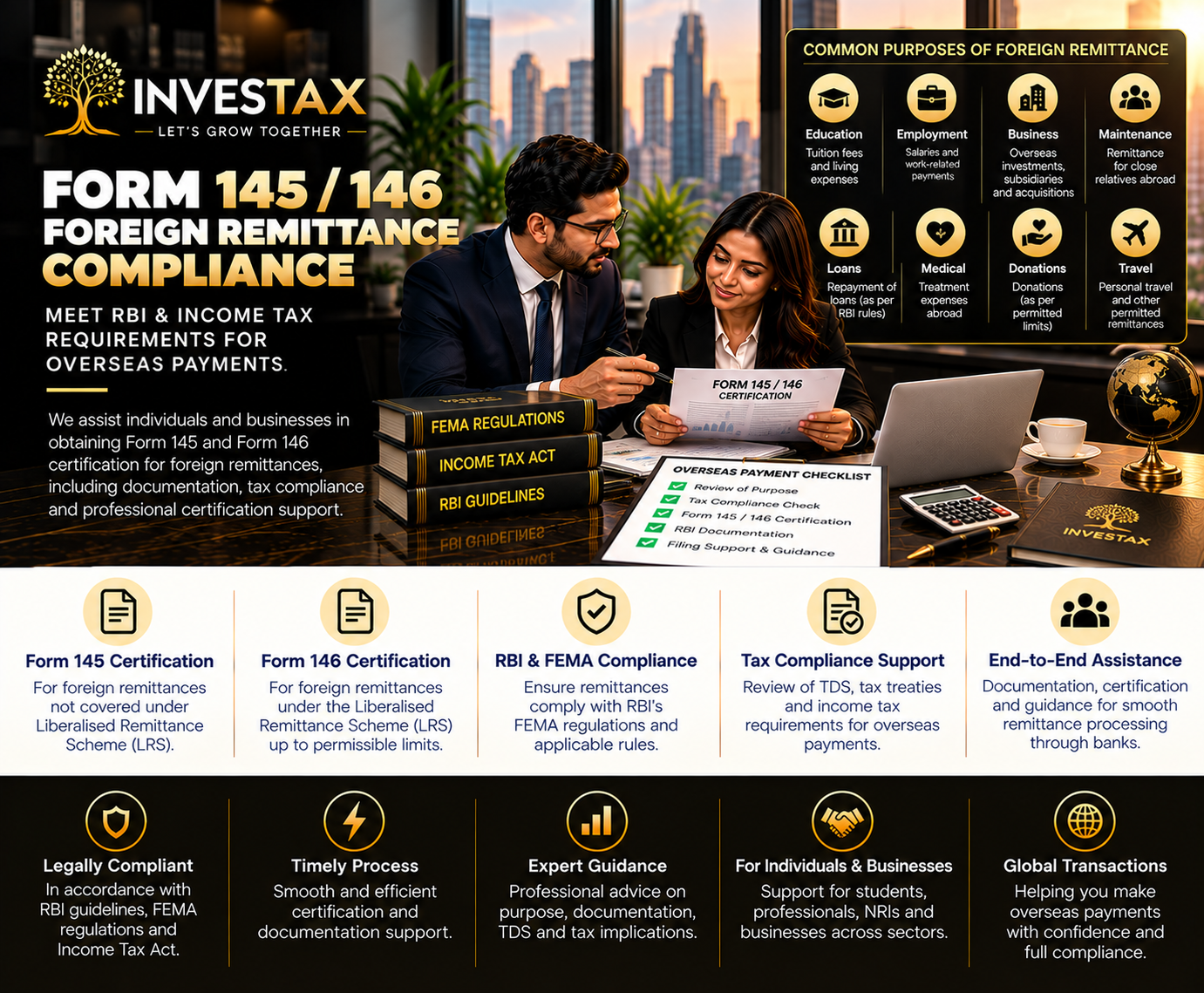
Form 145 & 146 – Foreign Remittance Compliance Services
Making a payment or remittance to a person or entity outside India can involve Income Tax, TDS, FEMA, RBI and banking compliance requirements.
Investax India provides professional assistance for Form 145 and Form 146 foreign remittance compliance, including taxability review, TDS determination, DTAA analysis, Chartered Accountant certification and documentation required for processing overseas payments.
Form 145 is the new Income-tax Rules, 2026 form corresponding to the earlier Form 15CA, while Form 146 corresponds to the earlier Form 15CB.
Whether you are making an overseas payment for professional services, software, royalty, commission, education, investment, business expenses or another permitted purpose, the correct tax and regulatory treatment should be determined before the remittance is made.
What Are Form 145 and Form 146?
Form 145 – Foreign Remittance Information
Form 145 is the declaration/information form for payments to a non-resident, not being a company, or to a foreign company.
It contains information relating to the remitter, recipient, nature and amount of remittance, taxability, TDS and other relevant details.
Form 146 – Chartered Accountant Certificate
Form 146 is the Accountant's certificate corresponding to the earlier Form 15CB.
It is used where the applicable conditions require a Chartered Accountant to examine the taxability of the foreign remittance, applicable TDS provisions and relevant Double Taxation Avoidance Agreement provisions.
Form 145 – Four Parts
Part A
Part A applies where the taxable remittance or aggregate of taxable remittances during the tax year does not exceed the prescribed threshold of ₹5 lakh.
Part B
Part B applies where the taxable remittance exceeds ₹5 lakh and an applicable certificate or order has been obtained from the Assessing Officer under the relevant provisions of the Income-tax Act, 2025.
Part C
Part C applies where the taxable remittance exceeds ₹5 lakh and the required Chartered Accountant certificate in Form 146 has been obtained.
Part D
Part D applies to remittances that are not chargeable to tax under the Income-tax Act, subject to the applicable exceptions and specified transactions for which information is not required.
When Is Form 146 Required?
Form 146 is an event-based Chartered Accountant certificate.
It is generally required where:
- The payment is being made to a non-resident or foreign company.
- The remittance is chargeable to tax in India.
- The payment or aggregate payments exceed ₹5 lakh during the tax year.
- An applicable Assessing Officer certificate/order has not been obtained.
- The conditions prescribed under the applicable Income-tax Rules are satisfied.
Form 146 is completed and certified by a Chartered Accountant through the Income Tax e-Filing system.
Form 145 & 146 – Who Needs It?
Foreign remittance compliance may be relevant to:
- Companies
- LLPs
- Partnership firms
- Proprietorship businesses
- Professionals
- Startups
- Exporters and importers
- Individuals making taxable overseas payments
- Businesses paying foreign consultants
- Businesses paying foreign technology providers
- Businesses making royalty or licence payments
Common Foreign Remittances Requiring Tax Review
Foreign remittance compliance can arise in connection with many different types of overseas payments, including:
- Professional and consultancy fees
- Technical services
- Software and technology payments
- Royalty payments
- Commission payments
- Interest payments
- Subscription and licensing charges
- Advertising and marketing services
- Cloud and technology services
- Legal and professional services
- Business support services
- Management fees
- Overseas contractor payments
- Education-related payments
- Medical expenses abroad
- Travel-related payments
- Investment-related remittances
- Gifts and donations
- Other permitted foreign exchange transactions
Taxability of Foreign Remittance
Not every payment made outside India is automatically taxable in India.
The taxability of a remittance depends on the nature of the payment, the recipient, the services or rights involved, the place and circumstances of the transaction and the applicable provisions of Indian tax law.
Therefore, before preparing Form 145 or Form 146, the underlying transaction should be examined to determine whether the payment is chargeable to tax in India.
TDS on Foreign Remittances
Where a payment to a non-resident is chargeable to tax in India, applicable TDS requirements need to be examined before making the remittance.
The appropriate TDS rate may depend upon the nature of payment, applicable domestic tax provisions, the status of the recipient and the availability of relief under an applicable Double Taxation Avoidance Agreement.
Correct determination of the taxable amount and TDS rate is therefore an important part of foreign remittance compliance.
DTAA – Double Taxation Avoidance Agreement
Where the recipient is a resident of a country with which India has an applicable Double Taxation Avoidance Agreement, the treaty provisions may need to be examined.
Depending on the nature of income and the applicable treaty conditions, the DTAA may affect the tax treatment or rate applicable to the payment.
Appropriate documentation, including tax residency and other treaty-related requirements where applicable, should be reviewed before claiming treaty benefits.
Form 146 and Tax Determination
Form 146 is not merely a declaration of the remittance amount.
The Chartered Accountant examines the remittance from the perspective of taxability and applicable provisions, including relevant provisions of the Income-tax Act and DTAA, where applicable.
The certificate can therefore involve examination of:
- Nature of payment
- Residential status of recipient
- Taxability in India
- Applicable TDS provisions
- Relevant DTAA provisions
- Applicable TDS rate
- Grossing-up requirements, where applicable
- Supporting agreements and invoices
- Tax residency documentation
- Other relevant supporting documents
Foreign Remittance Under LRS
Resident individuals may make certain permitted foreign exchange remittances under the Liberalised Remittance Scheme (LRS), subject to the limits and conditions prescribed by RBI.
Common purposes can include education, medical treatment, travel, gifts, maintenance of relatives abroad and other permitted transactions.
The applicability of Form 145 should not be determined solely by the fact that a transaction is an overseas remittance. The nature of the payment, taxability and applicable Rule 220 requirements must be considered.
Form A2 and Bank Documentation
Banks and authorised dealers may require documentation such as Form A2, purpose code, PAN, KYC documents, invoices, agreements and tax-related forms depending on the nature of the transaction.
Investax India can help coordinate the tax documentation required for submission to the bank or authorised dealer.
RBI, FEMA and Income Tax Compliance
Foreign remittances can involve more than Income Tax compliance.
Depending on the transaction, the following may need to be considered:
- Income-tax requirements
- TDS compliance
- Form 145
- Form 146, where applicable
- FEMA requirements
- RBI regulations
- LRS requirements for resident individuals
- Bank and authorised dealer documentation
- RBI purpose codes
- Supporting commercial documents
Documents Required for Foreign Remittance Compliance
- PAN of the remitter
- Details of the overseas recipient
- Recipient's country and address
- Invoice or payment request
- Agreement or contract, where applicable
- Nature and purpose of payment
- Amount and currency of remittance
- Bank details
- RBI purpose code
- Tax residency documents, where applicable
- Relevant declarations
- Previous remittance details, where relevant
- Other documents required based on the nature of the transaction
Our Form 145 & 146 Foreign Remittance Services
- Foreign remittance taxability review
- Form 145 preparation and filing assistance
- Form 146 Chartered Accountant certification
- TDS applicability review
- TDS rate determination
- DTAA applicability review
- Tax Residency Certificate documentation review
- RBI purpose-code guidance
- Supporting document review
- Bank documentation assistance
- Foreign remittance compliance coordination
- Assistance with tax and regulatory documentation
Foreign Remittance for Business Payments
Businesses frequently make overseas payments to foreign vendors, consultants, technology providers, software companies, group entities and other international service providers.
Before processing such payments, businesses should review the taxability of the payment and determine whether TDS and Form 145/Form 146 requirements apply.
Investax India helps businesses coordinate the tax review and documentation required before the payment is processed through the authorised dealer or bank.
Foreign Remittance for Individuals
Individuals may make overseas payments for education, medical treatment, travel, gifts, maintenance of relatives and other permitted purposes.
Not every individual remittance requires the same tax forms. The applicability depends on the purpose, taxability, RBI requirements and the specific conditions prescribed under the applicable rules.
We help individuals understand the documentation required for their specific remittance before approaching the bank.
Common Foreign Remittance Mistakes
- Making the payment before completing required tax documentation
- Assuming every foreign payment is tax-free
- Applying the wrong TDS rate
- Ignoring DTAA provisions
- Using an incorrect RBI purpose code
- Not maintaining the underlying agreement or invoice
- Ignoring tax residency documentation
- Confusing LRS compliance with Income Tax compliance
- Assuming Form 146 is required for every foreign remittance
- Failing to coordinate Form 145 with the bank's remittance process
Form 145 & 146 – Step-by-Step Process
- Understand the purpose and nature of the foreign payment.
- Identify the recipient and country of remittance.
- Review the applicable Income-tax provisions.
- Determine whether the payment is taxable in India.
- Check applicable TDS requirements.
- Review DTAA provisions where applicable.
- Determine the applicable Form 145 part.
- Obtain Form 146 certification where required.
- Complete the applicable Income Tax e-Filing requirements.
- Prepare the supporting bank documentation.
- Submit the required documentation to the authorised dealer/bank.
- Complete the remittance process.
- Maintain records for tax and regulatory purposes.
Why Choose Investax India?
- End-to-end foreign remittance compliance support
- Taxability and TDS review
- Form 145 filing assistance
- Form 146 CA certification support
- DTAA and international tax documentation review
- RBI and FEMA compliance coordination
- Bank documentation assistance
- Support for individuals and businesses
- Practical documentation guidance
- Professional support before the remittance is processed
Frequently Asked Questions
1. What is Form 145?
Form 145 is the Income-tax Rules, 2026 form used to furnish information relating to specified payments or remittances to non-residents and foreign companies. It corresponds broadly to the earlier Form 15CA.
2. What is Form 146?
Form 146 is the Chartered Accountant certificate corresponding to the earlier Form 15CB. It is used for applicable taxable foreign remittances where the prescribed conditions are satisfied.
3. Are Form 145 and Form 146 the same as Form 15CA and 15CB?
Form 145 corresponds to the earlier Form 15CA, while Form 146 corresponds to the earlier Form 15CB under the Income-tax Rules, 2026.
4. From when are Form 145 and Form 146 applicable?
For remittances made on or after 1 April 2026, the Income-tax Act, 2025 and Income-tax Rules, 2026 apply, including the prescribed Forms 145 and 146.
5. Is Form 146 mandatory for every foreign remittance?
No. Form 146 is not required for every overseas payment. It is generally relevant where the prescribed conditions for a taxable remittance exceeding ₹5 lakh are satisfied and the applicable Assessing Officer certificate or order has not been obtained.
6. Is Form 145 mandatory for every foreign remittance?
No. The applicable requirements depend on the taxability of the payment, amount, purpose and the exceptions and specified transactions provided under the applicable rules.
7. What is the ₹5 lakh threshold?
Under the current Rule 220 framework, the ₹5 lakh threshold is relevant to determining the applicable part of Form 145 and whether Form 146 certification is required for qualifying taxable remittances.
8. Who can issue Form 146?
Form 146 is a Chartered Accountant's certificate and is completed by a CA registered on the Income Tax e-Filing portal who has been appropriately assigned the form.
9. Does Form 146 need to be filed before the foreign remittance?
Where Form 146 is applicable, it should be completed before the remittance so that the required Form 145 Part C process can be completed.
10. Does every foreign payment attract TDS?
No. TDS depends on the taxability and nature of the payment under the applicable provisions. The transaction should be reviewed before determining the TDS obligation.
11. Can DTAA reduce the TDS rate?
An applicable DTAA may affect the tax treatment or rate subject to satisfaction of the treaty's conditions and required documentation.
12. Do I need a Tax Residency Certificate from the foreign recipient?
A Tax Residency Certificate and other supporting documentation may be required where treaty benefits are being considered. The exact documentation depends on the transaction and applicable treaty.
13. Does LRS apply to companies?
The Liberalised Remittance Scheme is a facility applicable to resident individuals subject to RBI rules. Businesses and companies have separate FEMA and foreign-exchange compliance considerations.
14. Do foreign education payments require Form 145?
The answer depends on the nature of the payment and the applicable Income-tax and RBI requirements. Individual remittances falling within specified exemptions may have different requirements.
15. Do foreign software payments require Form 145?
It depends on the nature of the software transaction, the rights acquired, the recipient and the applicable tax provisions. The payment should be reviewed before remittance.
16. What if the foreign payment is not taxable in India?
Depending on the circumstances, Part D of Form 145 may apply. Certain non-taxable remittances are also excluded from the information requirement under the applicable rules.
17. Can Form 145 be filed after making the remittance?
Form 145 should generally be completed before the remittance is made where it is applicable. The bank may require the relevant documentation before processing the overseas payment.
18. What documents should I provide to Investax India?
Typically, the invoice, agreement, recipient details, payment purpose, amount, country, bank details and relevant tax documents are required. Additional documents may be required depending on the transaction.
19. Can Investax India help with both Form 145 and Form 146?
Yes. Investax India can assist with foreign remittance taxability review, Form 145 compliance, Form 146 CA certification where applicable, TDS review, DTAA documentation and supporting bank documentation.
Send Overseas Payments with the Right Compliance in Place
Foreign remittance compliance involves more than transferring money through a bank. The taxability of the payment, TDS, DTAA, FEMA/RBI requirements, purpose code and applicable Income-tax forms should be reviewed before the transaction is processed.
Get professional assistance from Investax India for Form 145, Form 146 and complete foreign remittance compliance.
Need help with Form 145 / 146 – Foreign Remittance Compliance?
Get practical guidance on requirements, documentation, compliance and the right service for your needs.