Get Digital Signature
A Digital Signature Certificate helps individuals and organisations authenticate themselves and digitally sign documents and filings electronically. DSCs are issued by Certifying Authorities licensed under the Controller of Certifying Authorities (CCA) framework.
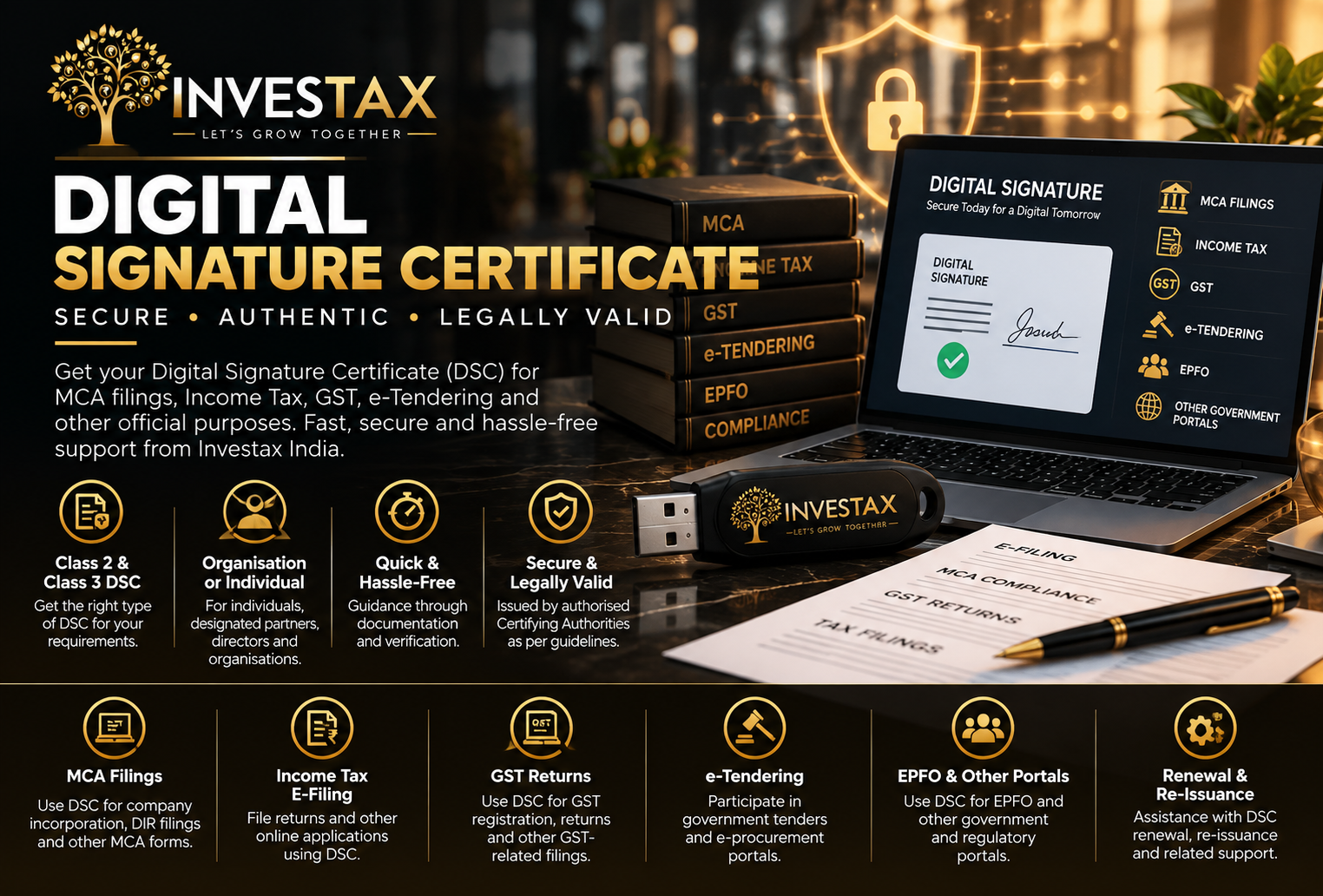
Digital Signature Certificate (DSC) Services
Secure. Authentic. Digitally Valid.
Digital transactions have become an essential part of modern business. Companies, directors, professionals, taxpayers and other users increasingly need digital signatures to authenticate themselves and sign documents electronically on government and business portals.
A Digital Signature Certificate (DSC) is an electronic certificate issued by a Certifying Authority (CA) licensed under the Controller of Certifying Authorities (CCA) framework. It can be used to establish the identity of the signer and digitally sign electronic documents and applications.
At Investax India, we assist individuals, businesses, directors, partners and professionals with DSC requirements, including application support, documentation, verification, renewal and related assistance.
What is a Digital Signature Certificate?
A Digital Signature Certificate is an electronic certificate used to authenticate a person or entity in electronic transactions and digital signing processes.
Under India's Information Technology framework, digital signatures based on the prescribed cryptographic infrastructure have legal recognition. The CCA regulates and supervises Certifying Authorities that issue Digital Signature Certificates under the applicable framework.
A DSC generally contains information that helps identify the subscriber and is associated with cryptographic keys used for creating and verifying a digital signature.
Who Issues Digital Signature Certificates?
The Controller of Certifying Authorities (CCA) does not ordinarily issue DSCs directly to end users. CCA licenses and regulates Certifying Authorities, and these licensed CAs issue Digital Signature Certificates to individuals and organisations.
Therefore, when obtaining a DSC, users should ensure that they obtain it through an applicable CCA-licensed Certifying Authority or its authorised process.
Types / Classes of Digital Signature Certificates
Digital Signature Certificates are issued under different assurance levels and certificate categories. The appropriate certificate depends on the requirements of the application or portal where the DSC will be used.
Class 1
Class 1 certificates have specified identity verification requirements and may use software-based private-key storage under the applicable framework.
Class 2
Class 2 certificates have defined identity verification requirements and require private-key generation and storage in a compliant hardware cryptographic device under the CCA framework.
Class 3
Class 3 certificates provide a higher assurance level and have specific identity verification requirements. The private key is required to be stored in a compliant hardware cryptographic device.
The CCA's current certificate-class guidance specifies the applicable identity-verification and key-storage requirements for different certificate classes.
Important: The certificate class required should be determined according to the requirements of the particular portal, application or transaction. A higher-assurance certificate may be accepted where a lower-assurance certificate is required, but users should verify the specific portal requirements before purchasing a DSC.
Where is a DSC Used?
Digital Signature Certificates are used across a wide range of electronic filing, authentication and business processes.
MCA / Corporate Filings
DSCs may be required by companies, directors, professionals and authorised persons for applicable electronic filings and submissions on the Ministry of Corporate Affairs system.
Income Tax E-Filing
Eligible taxpayers and authorised representatives may use digital signatures for applicable income-tax electronic filing and authentication requirements.
GST
Businesses and authorised users may require DSCs for specified GST-related registration, return filing or other electronic processes, depending on the applicable portal requirements.
e-Tendering & Government Procurement
Digital signatures may be required for participation in various government e-tendering and e-procurement platforms. The required certificate type depends on the particular tender or portal.
EPFO and Other Government Portals
DSCs may also be used for authentication or digital signing on certain government and regulatory portals where digital signature functionality is prescribed.
Benefits of a Digital Signature Certificate
- Digital Authentication: Helps authenticate the identity of the signer in electronic transactions.
- Electronic Signing: Enables users to digitally sign eligible electronic documents and applications.
- Security: Digital signature technology uses cryptographic mechanisms to protect the integrity and authenticity of signed information.
- Faster Filing: Enables electronic submission and signing without relying on physical document execution where digital signing is accepted.
- Paperless Processes: Supports digital business and government workflows.
- Convenience: Makes recurring electronic filings and submissions easier to manage.
- Regulatory Compliance: Helps users meet digital-signature requirements where a particular portal or process requires one.
How Does a Digital Signature Work?
- Identity Verification: The applicant's identity is verified through the applicable process prescribed by the Certifying Authority.
- Certificate Issuance: The licensed Certifying Authority issues the Digital Signature Certificate after completing the applicable verification requirements.
- Key Generation: The cryptographic keys associated with the certificate are generated and stored according to the applicable certificate requirements.
- Digital Signing: The subscriber uses the private key to create a digital signature on an electronic document or transaction.
- Signature Verification: The recipient or electronic system can verify the digital signature and associated certificate information.
The CCA framework includes requirements relating to identity verification, certificate issuance, cryptographic keys and interoperability between DSCs issued by licensed Certifying Authorities.
Documents & Information Required for DSC
The exact documents and verification process depend on the Certifying Authority, certificate type and applicant category.
Common information may include:
- Aadhaar or other prescribed identity information
- PAN details
- Mobile number and email address
- Photograph, where applicable
- Address details
- Organisation details, where applicable
- Authorisation documents for organisational applicants, where required
- Other information prescribed by the Certifying Authority
CCA guidance provides multiple identity-verification methods, including applicable Aadhaar eKYC and video or other prescribed verification processes.
DSC for Individuals
Individuals may require DSCs for various electronic filing, tendering, professional and government portal activities.
The appropriate certificate depends on the purpose for which the DSC is being obtained and the requirements of the relevant portal or application.
DSC for Companies & Organisations
Companies and other organisations may require DSCs for directors, authorised signatories, designated partners or other persons responsible for electronic filings.
Where an organisation has multiple authorised users, each person's DSC requirement should be assessed separately based on the relevant filing and portal requirements.
DSC for Directors & Designated Partners
Directors of companies and designated partners of LLPs may require digital signatures for applicable electronic corporate filings.
We assist with DSC-related requirements and help coordinate the documentation and verification process based on the relevant applicant and filing requirements.
DSC for Government E-Tendering
Many government and institutional procurement processes use electronic tendering systems. A valid DSC may be required to authenticate the bidder and digitally sign tender documents.
The exact DSC class, certificate type and registration requirements can differ between tendering platforms. Applicants should therefore check the specific tender and portal requirements before obtaining a certificate.
DSC Renewal & Re-Issuance
Digital Signature Certificates are issued for a defined validity period. When a certificate expires, a new certificate or renewal/re-issuance process may be required depending on the Certifying Authority and applicable service.
We assist users in planning DSC renewal and completing the applicable verification and issuance process.
DSC Replacement & Lost Token Support
A digital signature's private key is an important security credential. If a cryptographic token is lost, damaged or compromised, the appropriate action should be taken promptly according to the Certifying Authority's procedures.
Depending on the circumstances, revocation and issuance of a new certificate may be required.
DSC Security & Safe Usage
A DSC should be treated as a sensitive digital credential. The private key and cryptographic token should be kept securely under the control of the subscriber.
- Do not share your DSC token unnecessarily.
- Do not share PINs or passwords associated with the token.
- Use the DSC only for authorised transactions.
- Keep the token physically secure.
- Report suspected compromise or loss promptly.
- Verify the document or filing before signing.
- Use the applicable software and drivers required by the relevant portal.
The CCA framework contains specific requirements relating to secure storage of private keys for applicable certificate classes.
Digital Signature vs Electronic Signature
Digital signatures are a specific form of electronic signature based on digital certificate and cryptographic technology. The broader term "electronic signature" can include other legally recognised electronic signing methods.
The CCA also regulates eSign services that enable electronic signing using licensed Certifying Authorities and prescribed authentication mechanisms.
Common DSC Problems
Users may sometimes experience problems while using a DSC because of technical, certificate or portal-related issues.
- Expired DSC
- Incorrect or missing token drivers
- Browser or signing utility issues
- Certificate not detected by the portal
- Incorrect certificate selected
- Portal-specific compatibility requirements
- PIN or token access issues
- Certificate mismatch with the authorised user
- Incorrect certificate type for the intended application
Before purchasing or replacing a DSC, it is useful to identify whether the problem relates to the certificate, token, signing utility, browser, portal or user authorisation.
Why Choose Investax India?
- Application Assistance: Support with the DSC application and required information.
- Verification Guidance: Assistance in understanding the applicable verification process.
- Business-Focused Support: DSC solutions for companies, LLPs, proprietors, professionals and individuals.
- Portal-Based Guidance: Help identify the appropriate DSC requirement based on the intended use.
- Renewal Support: Assistance when an existing certificate approaches expiry.
- End-to-End Compliance Support: DSC assistance alongside MCA, Income Tax, GST and other business compliance services.
Frequently Asked Questions About Digital Signature Certificates
1. What is a DSC?
DSC stands for Digital Signature Certificate. It is an electronic certificate issued by a licensed Certifying Authority that can be used for authentication and digital signing in applicable electronic transactions.
2. Who issues Digital Signature Certificates in India?
Digital Signature Certificates are issued to end users by Certifying Authorities licensed by the Controller of Certifying Authorities (CCA). CCA regulates and supervises the licensed Certifying Authorities.
3. Is a Digital Signature legally valid in India?
Digital signatures meeting the applicable requirements of India's Information Technology framework have legal recognition. The IT Act provides legal recognition to digital signatures based on prescribed asymmetric cryptosystems.
4. What is the difference between Class 2 and Class 3 DSC?
The classes represent different assurance and verification requirements. Under the CCA's current guidance, Class 3 has higher assurance requirements than Class 2, and both have specified requirements for secure hardware-based private-key storage.
5. Which DSC should I buy?
The appropriate DSC depends on the portal, application or transaction for which it will be used. The required certificate class and attributes should be checked against the requirements of the relevant portal before purchase.
6. Can a DSC be used for MCA filings?
Yes, digital signatures are used for applicable electronic corporate filings and submissions. The particular user and certificate requirements depend on the filing and MCA process involved.
7. Can a DSC be used for Income Tax filing?
Yes, digital signatures can be used for applicable Income Tax electronic filing and authentication processes where the relevant facility and requirements apply.
8. Can a DSC be used for GST?
Yes, DSC functionality is used for specified GST electronic processes. The exact requirement depends on the taxpayer, filing and portal process.
9. Can a DSC be used for e-Tendering?
Yes, many electronic tendering and procurement platforms use digital signatures. The required certificate type and registration procedure depend on the particular tendering platform.
10. How long is a DSC valid?
The validity period depends on the certificate and Certifying Authority selected. The validity should be checked at the time of issuance, and the certificate should be renewed or re-issued before expiry where continued use is required.
11. What happens if my DSC expires?
An expired certificate generally cannot be used for transactions requiring a valid certificate. A new certificate or applicable renewal/re-issuance process may therefore be required.
12. What happens if my DSC token is lost?
If the token containing the private key is lost, the subscriber should promptly contact the relevant Certifying Authority and follow its security and revocation procedures. A replacement certificate may be required depending on the circumstances.
13. Can I use one DSC on multiple portals?
A DSC may be usable across multiple compatible portals, but each portal can have its own certificate, registration, software and technical requirements. Users should verify the requirements of each portal.
14. Can one person have multiple DSCs?
Yes. CCA guidance states that a person may obtain multiple certificates from different Certifying Authorities, subject to the applicable requirements.
15. Is Aadhaar required for DSC?
Depending on the applicable issuance process, Aadhaar-based eKYC may be one of the available identity-verification methods. Other prescribed verification methods may also be available.
16. Do companies need a DSC?
Companies may require DSCs for directors, authorised signatories, professionals or other persons responsible for electronic filings, depending on the applicable filing and portal requirements.
17. Do LLP partners need DSC?
Designated partners or other authorised persons may require DSCs for applicable electronic LLP filings. The requirement depends on the specific filing and portal process.
18. Can I share my DSC with my accountant?
A DSC and its private key should be treated as sensitive security credentials. The subscriber should maintain control over the private key and token and should avoid sharing PINs or credentials. Where an accountant or professional needs to file on behalf of a client, the appropriate authorisation and portal procedures should be followed.
19. How can I get a Digital Signature Certificate?
An applicant can approach a CCA-licensed Certifying Authority and complete the applicable application, identity-verification and issuance process. Investax India can assist with the process and related documentation.
Get Your Digital Signature Certificate With the Right Support
Whether you need a DSC for MCA filings, Income Tax, GST, e-Tendering or another electronic application, selecting the appropriate certificate and completing the required verification correctly can make the process easier.
Contact Investax India for Digital Signature Certificate application, renewal and related support.
Need help with Get Digital Signature?
Get practical guidance on requirements, documentation, compliance and the right service for your needs.