
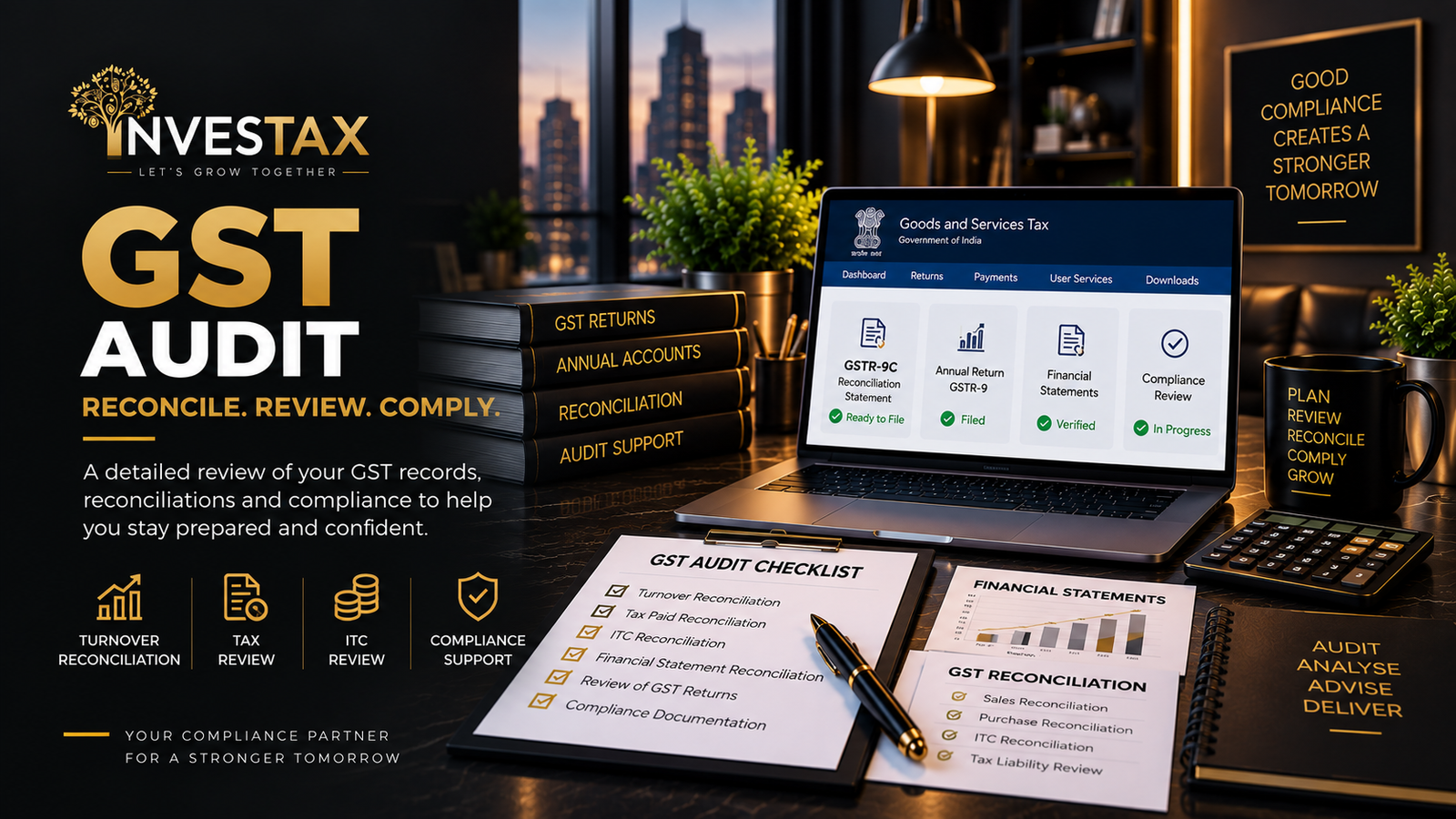
GST Audit & Reconciliation — Reconcile. Review. Comply.
GST compliance involves more than filing periodic returns. A detailed review of GST records can help identify differences between books, returns, tax payments, input tax credit and other relevant information.
Investax India helps businesses review GST records, reconcile relevant figures and prepare for annual reconciliation, departmental audit or other GST audit-related requirements.
What Is GST Audit?
The term "GST Audit" is commonly used for different types of GST-related reviews. Under the current GST framework, businesses should distinguish between internal GST review and reconciliation, GSTR-9C reconciliation requirements, departmental audit by the GST authorities and special audit directed under the GST law.
The earlier mandatory audit of accounts under Section 35(5) of the CGST Act is no longer applicable. For specified taxpayers, the current framework instead requires a self-certified reconciliation statement in Form GSTR-9C when the applicable turnover threshold is exceeded.
GSTR-9C — GST Reconciliation Statement
A registered person whose aggregate turnover during the relevant financial year exceeds the prescribed threshold is required to furnish a self-certified reconciliation statement in Form GSTR-9C along with the applicable annual return, subject to the provisions and exemptions applicable for that financial year.
Under the current Rule 80 framework, the specified threshold for GSTR-9C is aggregate turnover exceeding ₹5 crore during the financial year.
GSTR-9C is designed to reconcile relevant figures reported in the annual GST return with the corresponding figures in the annual financial statements and explain applicable differences.
What We Review During GST Reconciliation
- Turnover reported in books
- Turnover reported in GST returns
- Taxable turnover
- Output tax liability
- Tax payments
- Input tax credit
- Credit and debit notes
- Exempt and non-GST supplies
- Exports and zero-rated supplies
- Reverse-charge transactions
- Amendments reported during the year
- Other relevant GST records
Our GST Audit & Reconciliation Services
GST Records Review
We review relevant GST records, returns, books and supporting documents to identify apparent inconsistencies and areas requiring further examination.
Turnover Reconciliation
We compare turnover reported in the books of accounts with turnover reported through GST returns and investigate relevant differences.
Tax Liability Review
We review applicable output tax liability against GST returns, books and payment records to identify apparent differences.
Input Tax Credit Review
We review the input tax credit position using relevant purchase records, GST portal information and return data.
GSTR-9C Support
Where GSTR-9C is applicable, we assist with the relevant reconciliation process and preparation of the self-certified reconciliation statement.
GST Audit Preparation
We help organise records and supporting information required for a GST audit or scrutiny-related process and assist in reviewing potential areas of concern.
Audit Observation Support
Where GST authorities identify discrepancies during an audit or scrutiny process, we can assist with reviewing the observations and preparing relevant supporting information and responses.
Departmental GST Audit Under Section 65
Under Section 65 of the CGST Act, the proper officer may undertake an audit of a registered person. The audit can cover a financial year or multiple financial years and involves examination of relevant books, records, returns and other information.
The GST authorities may examine matters including turnover, exemptions and deductions, tax rates, input tax credit availed and utilised, refunds and other relevant issues.
Where a departmental audit is undertaken, the taxpayer may receive an audit notice in Form GST ADT-01 and the findings are communicated through the prescribed process.
Special Audit Under Section 66
A special audit may be directed in specified circumstances where the proper officer, with the required approval, considers that the value has not been correctly declared or that the input tax credit availed is not within normal limits, having regard to the nature and complexity of the case and the interest of revenue.
In such cases, the registered person's records may be directed to be examined and audited by a Chartered Accountant or Cost Accountant nominated by the Commissioner.
Our GST Audit Preparation Process
- Understand the Business — Review the nature of the business, GST registrations and transaction profile.
- Collect Records — Obtain books, GST returns, sales and purchase registers and other relevant records.
- Review GST Returns — Examine relevant GSTR-1, GSTR-3B, GSTR-2B and other applicable GST information.
- Reconcile Turnover — Compare GST-reported turnover with books and financial records.
- Review Tax — Examine output tax, reverse charge and tax payment information.
- Review ITC — Reconcile input tax credit and identify apparent differences or reversals.
- Identify Differences — Document material or apparent differences requiring clarification.
- Prepare Supporting Records — Organise relevant invoices, registers, reconciliations and explanations.
- Final Review — Review the GST position and prepare for the applicable filing, reconciliation or audit process.
GST Turnover Reconciliation
Turnover reconciliation is an important part of GST review. Differences can arise between financial statements and GST returns because of accounting adjustments, exempt supplies, exports, credit notes, advances, timing differences and other transaction-specific matters.
Our Turnover Review Includes
- Books versus GSTR-1
- GSTR-1 versus GSTR-3B
- Books versus annual return
- Taxable versus non-taxable turnover
- Credit and debit notes
- Exports and zero-rated supplies
- Other applicable adjustments
GST Input Tax Credit Review
Input tax credit is an important area of GST compliance. We review relevant purchase records, GSTR-2B and GST returns to identify apparent mismatches, duplicate credit, reversals and other matters requiring attention.
The GST Portal advises taxpayers to reconcile GSTR-2B with their own records and books and to ensure that credit is not availed twice and applicable reversals are appropriately dealt with.
ITC Review Areas
- Purchase register reconciliation
- GSTR-2B reconciliation
- Duplicate credit review
- Credit reversal review
- Reverse-charge transactions
- Blocked or potentially ineligible credit review
- Unmatched invoices
Common GST Audit Issues
- Difference between books and GST returns
- Turnover mismatch
- Incorrect tax classification
- Incorrect tax rate application
- Input tax credit mismatch
- Duplicate ITC claims
- Unreconciled credit notes and debit notes
- Reverse-charge differences
- Incorrect reporting of exempt supplies
- Differences between GSTR-1 and GSTR-3B
- Differences between GSTR-3B and GSTR-2B
- Insufficient supporting documentation
GST Audit Documentation
The records required depend on the nature of the review or audit. Relevant documentation may include:
- Books of accounts
- Sales register
- Purchase register
- GST returns
- GSTR-2B
- Financial statements
- Tax payment records
- Invoices and credit/debit notes
- E-invoice records, where applicable
- E-way bill records, where applicable
- Reconciliation statements
- Other relevant supporting documents
Who May Need GST Audit or Reconciliation Support?
GST review and reconciliation can be relevant for businesses of different sizes, particularly where the volume or complexity of transactions makes detailed reconciliation important.
- Businesses with significant GST turnover
- Businesses required to furnish GSTR-9C
- Businesses with multiple GST registrations
- Businesses with significant input tax credit
- Businesses with high transaction volumes
- Businesses receiving GST audit or scrutiny notices
- Businesses undergoing merger, restructuring or closure
- Businesses seeking a year-end GST health check
GST Audit vs GSTR-9C
GST audit and GSTR-9C should not be treated as identical concepts.
- GSTR-9C is a prescribed reconciliation statement for specified taxpayers above the applicable turnover threshold.
- Departmental Audit is an audit conducted by GST authorities under Section 65.
- Special Audit is a separate process under Section 66 that may be directed in specified circumstances.
- Internal GST Review is a voluntary compliance exercise undertaken to identify and address potential issues before they become larger problems.
Why Choose Investax India?
Reconciliation-Focused Approach
We focus on understanding the underlying records and reconciling relevant GST information rather than treating compliance as a simple form-filling exercise.
Detailed Record Review
Our process considers books, returns, GST portal data and supporting records to identify apparent differences.
Structured Documentation
We help organise relevant reconciliations, supporting documents and explanations for the applicable GST compliance requirement.
End-to-End GST Support
Our GST services can extend from registration and return filing to annual reconciliation, GSTR-9C support and audit-related assistance.
Frequently Asked Questions
Is GST audit still mandatory for businesses?
The earlier mandatory audit of accounts under Section 35(5) of the CGST Act is no longer applicable. Specified taxpayers may instead be required to furnish a self-certified GSTR-9C reconciliation statement based on the applicable turnover threshold.
What is the current GSTR-9C threshold?
Under the current Rule 80 framework, a registered person whose aggregate turnover during the financial year exceeds ₹5 crore is required to furnish a self-certified GSTR-9C, subject to the applicable provisions and exemptions.
Who conducts a departmental GST audit?
A departmental audit under Section 65 is conducted by the proper officer authorised under the GST law.
What is a special GST audit?
A special audit under Section 66 may be directed in specified circumstances and involves examination of records by a Chartered Accountant or Cost Accountant nominated by the Commissioner.
Does GSTR-9C need to be certified by a Chartered Accountant?
The current framework provides for a self-certified reconciliation statement in Form GSTR-9C for taxpayers meeting the applicable threshold. The earlier requirement for certification by a Chartered Accountant or Cost Accountant was changed by the amendments to the GST law.
Can Investax India help with GST audit preparation?
Yes. We can assist with GST records review, turnover reconciliation, tax review, ITC reconciliation, GSTR-9C support and preparation of relevant records for GST audit or scrutiny-related proceedings.
Be Audit-Ready. Stay GST-Ready.
A well-organised GST reconciliation process can help businesses understand their GST position before an issue becomes a compliance problem. Investax India helps you review records, reconcile GST data and prepare for applicable annual reconciliation, audit or scrutiny requirements.
GST Audit | GST Reconciliation | GSTR-9C | ITC Review | Turnover Reconciliation | GST Compliance